Guide · 5 min read
Team Health 101
What a team health check is, why most of them fail, and how to run one your team will actually answer.
A team health check is a short, recurring survey a team takes about itself: how safe it feels to speak up, whether people can rely on each other, whether the work has a clear purpose. It is not a performance review and it is not an HR engagement survey. The team owns the questions, the team sees the results, and the team decides what to do about them.
This guide covers the research behind the questions, the anonymity rules that make people answer honestly, a cadence that avoids survey fatigue, and — the part most programs skip — what to do with the result.
Why most health checks fail
Three patterns show up again and again in teams that tried a health check and dropped it:
- The survey is too long. Twenty questions once a quarter produces a number nobody remembers by the time the next one arrives.
- Anonymity is a promise, not a mechanism. On a team of five, a free-text comment identifies its author by style. People learn this after one round and stop writing.
- Nothing happens next. The result lands in a dashboard the team doesn’t open. A low score with no follow-up teaches the team that answering honestly changes nothing.
Everything below is designed around those three failures.
The five categories
Google’s Project Aristotle studied 180 teams to find what separated the most effective ones. It wasn’t who was on the team; it was how the team worked together, across five dynamics. Parabol’s Team Health question bank maps every question to one of them.
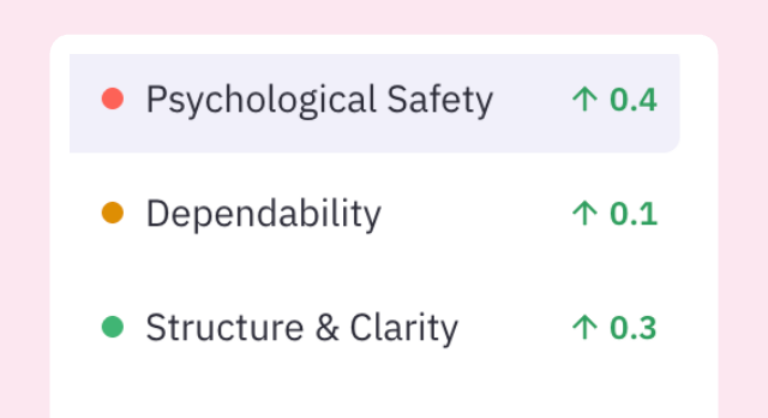
- Psychological Safety
- Can I take a risk or admit a mistake without it being held against me?
- Dependability
- Do teammates deliver quality work on time?
- Structure & Clarity
- Are goals, roles and plans clear?
- Meaning
- Is the work personally important to me?
- Impact
- Can I see that our work matters?
Psychological safety topped Google’s list and it is the one most other frameworks converge on — Edmondson’s seven-question survey is entirely about it. Structure & Clarity and Meaning overlap heavily with Gallup’s Q12. Parabol ships those instruments as question packs so you can start from a validated set rather than writing your own.
Anonymity rules worth enforcing
Honest answers need a guarantee people can verify, not a sentence in the intro. Four rules, all of which Parabol enforces in software:
- Individual scores are never shown to anyone. Not the lead, not an admin. Only aggregates.
- Results are withheld until the check closes. If scores updated live, the third person to answer would be identifiable by the delta.
- Nothing reveals below a minimum number of respondents. One or two answers are a person, not a team.
- Anonymous comments are reworded before anyone reads them. AI paraphrasing removes the writing-style fingerprint while keeping the meaning.
Cadence: one question per category
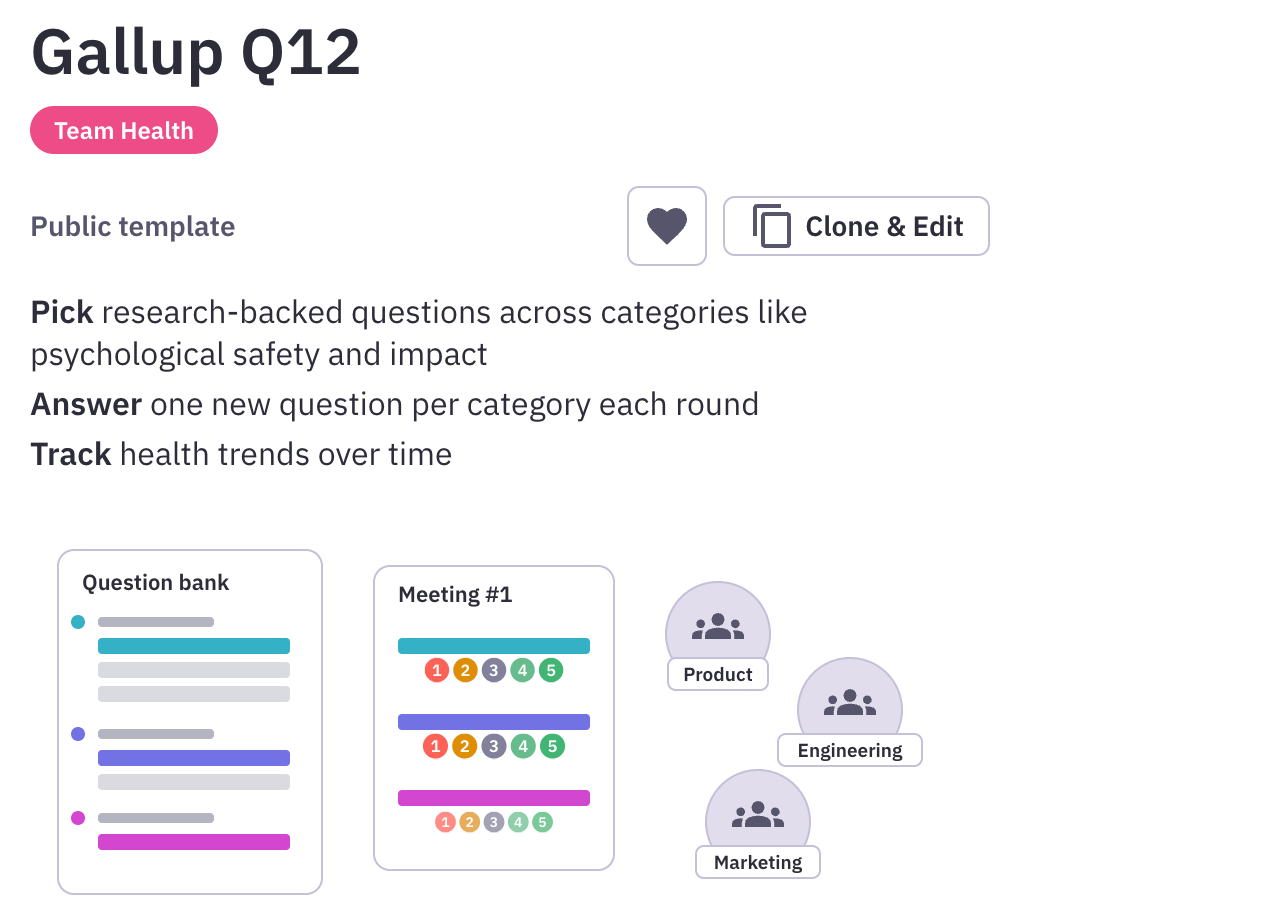
The antidote to the twenty-question quarterly survey is a five-question check every sprint. One question from each category, rotating through the pack, so the full set is covered every three or four checks and no single check takes more than about two minutes.
Run it either as its own recurring meeting — opened Monday, auto-revealed Friday, with a reminder to anyone who hasn’t answered — or as the opening phase of the retro, so the discussion happens while the numbers are fresh.
Reading the result
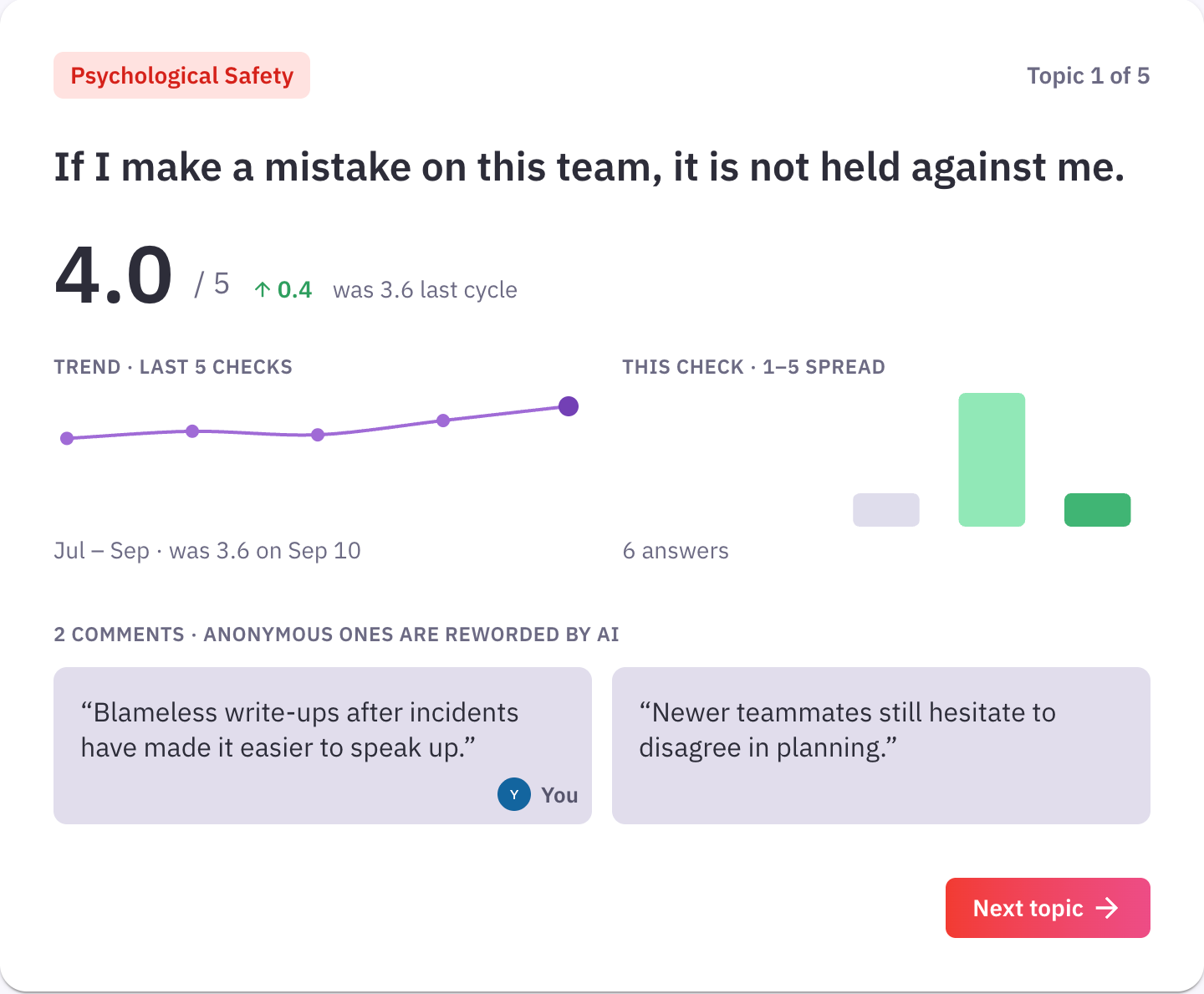
A single score tells you where you are. The useful information is in two other places:
- The change since last check. A 3.4 that was 3.0 is a team getting better; a 3.4 that was 3.8 is a team that needs a conversation. Parabol shows the delta on every category.
- The spread. Five people at 3 is a shared view; three at 5 and two at 1 is a split team — and the more interesting retro topic.
Don’t rank teams against each other. Scores are a conversation starter for the team that produced them; compared across teams they become a league table, and league tables end honest answering.
Closing the loop
The check earns its two minutes only if something happens next. The pattern that works:
- Reveal the results in the retro, or open the discussion thread on the lowest or most-changed category.
- Pick one thing to try before the next check — not a plan for everything.
- Make it a task with an owner, synced to the backlog the team already uses.
- Look at the delta next check. If it moved, say so out loud.
That last step is what turns a survey into a system. The team learns that answering honestly leads to a change, and that the change is measured — which is the only durable reason to keep answering.
Frameworks to go deeper
- Google Project AristotleThe study behind the five categories
- Psychological SafetyEdmondson’s validated 7-question survey
- Team Diagnostic SurveyHackman’s enabling conditions
- Gallup Q1212 questions that predict engagement
- Spotify Squad Health CheckThe traffic-light workshop
- Atlassian Team Health Monitor8 attributes, rated out loud
- Five Dysfunctions of a TeamLencioni’s trust-to-results pyramid
- Google Project OxygenWhat great managers do
- SCARFFive social drivers of threat and reward