#518 – Groups That Stick
Friday Ship #518 | November 20th, 2026
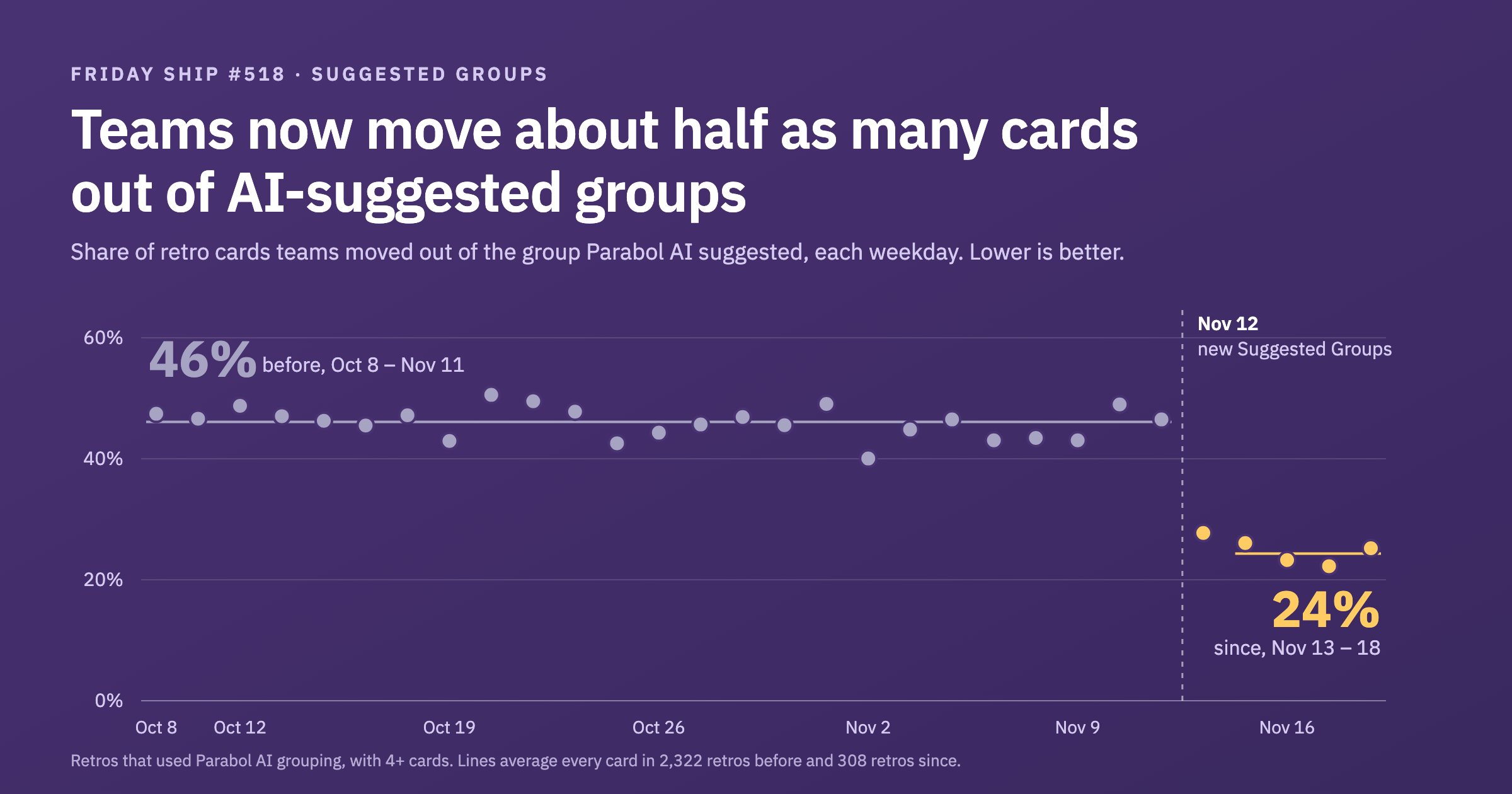
This week we checked our homework on Suggested Groups.
In Friday Ship #517 I wrote that we’d made Suggested Groups better and faster to use. That was a promise. This week we went back and measured it, and the numbers turned out better than we’d hoped: since the change, teams move about half as many cards out of the groups Parabol AI suggests.
Worse than nothing
In a retro’s group phase, the team sorts everyone’s reflections into themes. Suggested Groups takes the first pass so the team only has to fix what it got wrong.
That gives us a simple yardstick. When the group phase ends, how many cards did the team move out of the group Parabol suggested? Fewer is better. A perfect suggestion means nobody moves a thing.
When we finally measured our old suggestions this way, the answer stung. We replayed 300 real retros through them, and they left teams more cards to move (46%) than leaving every card on its own would have (42%). Our AI was too eager. It lumped together cards that teams wanted to keep apart, often from different columns, and teams spent the group phase pulling them back out.
What we changed
We shipped four changes in three releases over about 20 hours, from late Wednesday, November 11 (v15.27.0) to Thursday evening (v15.30.0):
- Smaller, more specific groups. We rewrote the instructions we give the AI. It now aims for small, specific groups, mostly within a single column, the way teams actually group. Replaying the same 300 retros, the new instructions cut the cards teams would have had to move from 46% to 28%.
- One column at a time. Instead of one big request for the whole board, Parabol now asks for suggestions column by column. In a second round of experiments we tried a stack of tweaks, and this was the only one that still helped on fresh retros the AI hadn’t seen before.
- A briefing on your team. The AI grouping a retro only sees the new cards. It can’t tell that “the migration,” “Project Falcon” and “FMS” might all be the same thing, or who “Dana” is. So when a retro ends, Parabol AI now reads the team’s last six months of retros and writes a short briefing with the people, projects, acronyms and goals a long-time member would know. It never sees who wrote which card. The next time the team groups, the AI reads the briefing first.
- Accept all, with an exact Undo. One click forms every suggested group, without breaking up groups people already made. Undo puts back only the cards still where Accept all left them.
We also gave Suggested Groups a scoreboard. For every retro, Parabol now records how many cards the team moved by the end of the group phase, along with which model ran, what it cost and whether we had to repair any of its answers. For the weeks before we started recording, we re-ran the same count on the suggestions we’d already saved. That’s what made the rest of this post possible.
What happened
We started by comparing last Friday, the first full day with everything live, against the five Fridays before it. On those Fridays, teams moved 46% of the cards out of the AI’s suggested groups. Last Friday, they moved 26%. Our replay had predicted 28%.
One good day can be a fluke, so we waited for this week’s retros too. Monday through Wednesday, teams moved 24%. In the five weeks before the change, not one weekday came in under 40%. Since the change, not one has come in over 28%.
A few more things we learned:
- One retro in five now keeps every suggested group exactly as it was, up from one in forty.
- It helps on boards of every size. Boards with 10 or fewer cards gained the most (46% of cards moved, down to 13%), and even boards with more than 35 cards went from 46% to 30%.
- It’s the suggestions, not the button. Accept all makes it easy to say yes, so we looked at Thursday’s retros from before it shipped. Teams were already down to 28%.
- Most of it is the AI. Teams without Parabol AI get our older grouping, which matches cards with similar wording. It picked up Accept all and the one-column-at-a-time change too, plus a new model for spotting cards that say the same thing, and went from 34% to 28%. The AI’s suggestions improved more than three times as much.
Every move counts
A week of retros is a strong start, not the final word. A team only gets its briefing after its next retro ends, so some teams are still grouping without one. We’ll keep watching as those fill in.
The bigger change is that we don’t have to guess anymore. Every retro now tells us how its suggestions did, so the next idea can be measured against real teams the day it ships, not weeks later in a spreadsheet.
If your team tried Suggested Groups a while back and gave up on it, give it another look. If it still puts a card in the wrong place, go ahead and move it. That’s exactly what we count. And if your team is measuring an AI feature out in the wild, I’d love to compare notes.
Metrics
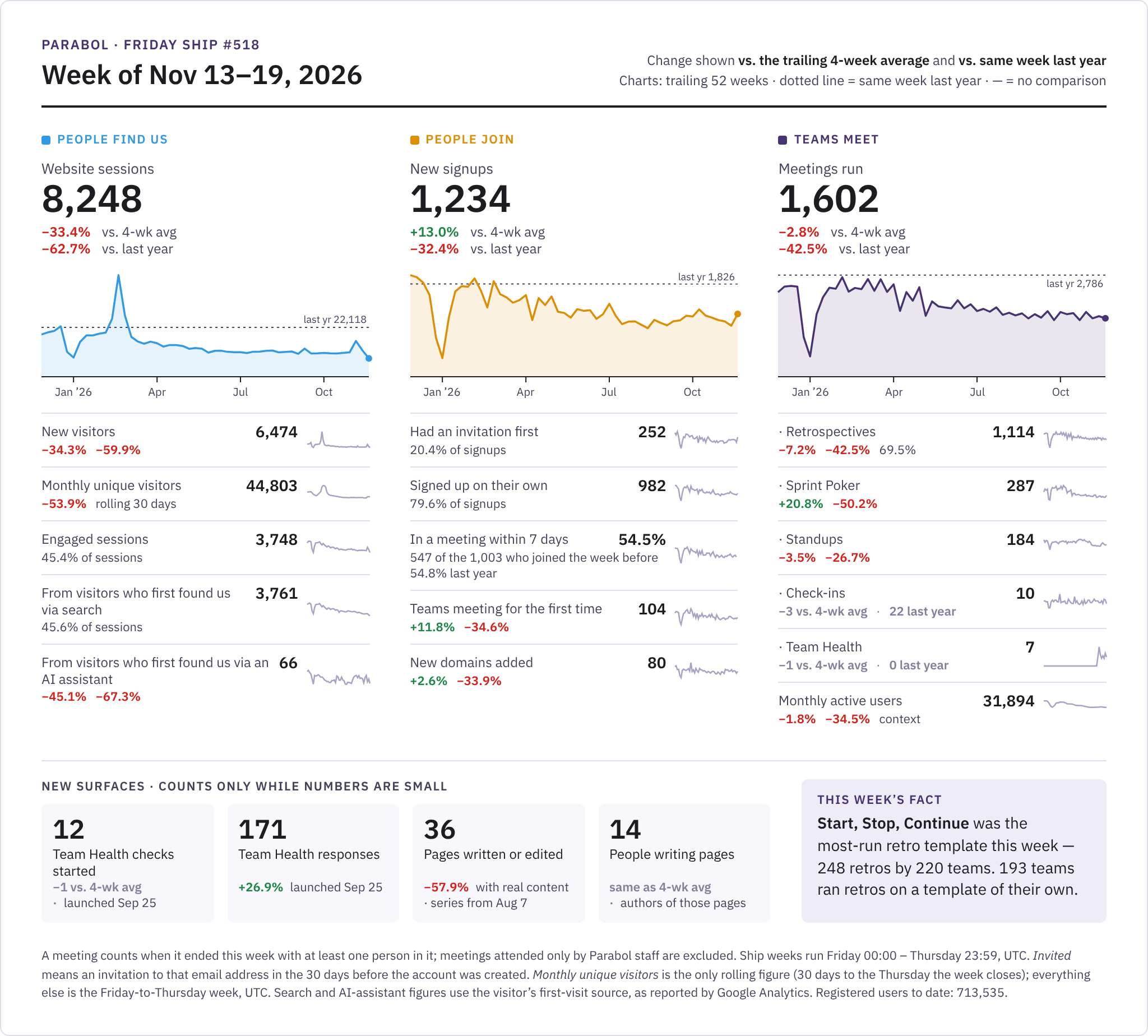
New signups jumped to 1,234 this week, 13.0% above the four-week average, and 104 teams met in Parabol for the first time, up 11.8%. Teams ran 1,602 meetings, close to their four-week average (−2.8%), and Sprint Poker had a big week, up 20.8%. Of the people who signed up the week before, 54.5% ran a meeting within seven days, just shy of 54.8% at this time last year.
Website sessions (8,248) fell 33.4% below their four-week average, but about half of that drop is a change in how we count. Since November 12, parabol.co asks visitors in Europe, the UK, Brazil and Quebec before it loads Google Analytics, and we only count the ones who say yes. Leaving those places out of every week, sessions were down 21%.
This week we…
…shipped synced blocks in Pages. Write a block once, place it on as many pages as you like, and an edit in one place shows up everywhere. Synced blocks work in search, print, export, Trash and Turn into. If you want a copy to go its own way, Unsync it.
…made it easy to move things around in Pages. Drag blocks onto a page in the sidebar, or move them with the keyboard or the page picker. Select several blocks and they move together as one group, with an action bar for what you can do next. You can also move blocks up or down, duplicate or copy a whole page, and mix bulleted and numbered items in one nested list. And as promised last week, you can select some text and turn its block into another type right from the text menu.
…turned the retro inspiration drawer into a timeline. It shows what your team did since the last retro, so you have something to reflect on before you start typing. The list appears right away, with each day folded down to its five most notable items. Then Parabol AI reads across the whole range and drafts up to six reflections for you, each based on one issue or a theme across many. Sources fit on one row, and the rest wait in a More tray.
…let you change a retro’s template and settings mid-meeting. Last week it was standups. For retros, open the new Settings tab in the meeting drawer.
…moved Parabol to a new license. In v16.0.0, Parabol’s code moved from the AGPL to the Business Source License (BSL). The source is still public, but self-hosted installs now need a signed license key to start. If you run Parabol yourself, get in touch and we’ll set you up.
…opened Pages to API agents. Agents with an API token can now read and edit page content. A token only reaches the files its owner can, and we now store personal access tokens hashed.
…smoothed out tasks and integrations. A team with no tasks yet sees an example card. Hover a task’s issue link to see its status in the other tool. Parabol nudges you to add a task on the last retro topic. Jira projects, repos and projects from other tools show up right after you connect. And the send button stays out of the way until you hover a task card.
…made Parabol faster to open. Every screen now runs on a new router, and pages start loading their data before the screen draws, so you’ll see fewer spinners. Team Health cards and the meeting control bar also fit on phones now.
…fixed a stack of smaller things. Renaming a meeting now updates its Slack message. Sharing a page link no longer sends an invite email to “*”. Removed users stop getting notification summaries. GitLab search handles rate limits and refreshes its tokens. A recurring meeting you start on its first occurrence keeps running. Going straight from one meeting to another no longer crashes, and neither does pasting into a page title. The retro demo now has a tasks list. Typing still works when your browser’s storage is full. Only Parabol can downgrade an Enterprise organization. A Confluence export made with a page-limited token stays within that page. Beetee, our bug-fixing AI agent, got 13 fixes merged since last Friday, and it can now commit its own fixes for review.
Next week we’ll…
…start week 1 of Shape Up Cycle 17.
…let you check your team’s health inside a retro. Answer the Team Health check and review the results together, without leaving the meeting. It’s in review.
…let you connect Claude, ChatGPT and other AI apps to Parabol. Sign in once and your AI app can work with your Parabol data. Org admins will choose which AI apps can connect, see which ones have, and revoke them. (At least, if these marketplaces approve our apps quickly…)
…open Reports to the org you looked at last. It’s in review.

Jordan Husney
Jordan is Parabol’s CEO and Head of Product. He was previously a Director at Undercurrent, where he advised C-Suite teams of Fortune 100 organizations on the future of work. Jordan has an engineering background, holding several patents in distributed systems and wireless technology. Jordan lives in Minneapolis, MN.