#515 – Robots at the Gates
Friday Ship #515 | October 30th, 2026

This week we took a detour from our reporting work to plug a number of security holes.
Last week, in Friday Ship #514, I wrote that I was anxious critical CVEs would become the new normal. I didn’t expect to feel it so soon.
One, two, three
First, PHP. On October 21, PHP shipped an emergency release for “PHP2Shell,” two bugs that, under the right conditions, let anyone on the internet run code on a PHP server without logging in. Ryan Austin at the security firm Calif found the first one with an AI model as his research partner, and OpenAI independently reported the same root cause. Attackers weren’t far behind: Amazon spotted an exploit attempt four days before the fix was public.
Then, Brotli. That same week, fixes landed for a critical bug in Brotli, Google’s compression library, which is quietly bundled inside Node.js and a long list of other software. The Node.js project credits OpenAI’s Codex Security team with the find. Parabol runs on Node.js, so this one landed close to home.
Then, Chrome. On Tuesday, Chrome 156 shipped 52 security fixes. The top one, a critical flaw that could let a malicious web page run code outside Chrome’s sandbox, is credited to an Anthropic researcher working with Claude.
By Tuesday, CISA had added both PHP bugs and the Brotli bug to its catalog of vulnerabilities being actively exploited. That’s three critical holes, in three pieces of software that hold up much of the web, in a single week, and AI had a hand in finding every one of them.
How we got here
Machines hunting for bugs isn’t new. DARPA ran the first all-machine hacking tournament back in 2016. In late 2024, Google’s Big Sleep agent found a bug in SQLite, which Google called the first public case of an AI agent finding an unknown, exploitable memory-safety bug in widely used software. This April, Anthropic said its Claude Mythos Preview model had found thousands of high-severity vulnerabilities, including one that had been hiding in OpenBSD for 27 years.
Now the volume is showing up in the numbers. Google’s threat intelligence team counted 5,045 newly published vulnerabilities in January of this year and 10,740 in August. That’s more than double in seven months.
The people closest to the work have changed their tune. Daniel Stenberg, who maintains curl and spent last year complaining about AI-generated junk bug reports, now argues that any project not scanning its own code with AI is handing attackers a head start. The UK’s National Cyber Security Centre is telling every organization, whatever its size, to get ready for a “patch wave.”
Bruce Schneier and Barath Raghavan put it plainly back in April. We’re in for:
a few years of constant hacks until we arrive at a new normal
That new normal, they write, is one where software gets checked carefully and patched continuously.
Patching our own walls
So we pulled people off Reports and pointed them at Parabol itself. (Reports still landed behind its flag this week, more on that below, but launch work slowed down.)
- Pages and live editing. Page access is now rechecked on every live editing connection and taken away the moment someone leaves the team or org that granted it. Styles, embeds and other content added in the editor are sanitized, images added from other sites are now hosted by Parabol, and a failure in our realtime layer no longer takes a server down with it.
- Malformed requests. A single request with an unusual header could crash one of our web servers. Now we close that connection and carry on.
If robots are going to find the cracks in our walls, we’d rather they be our robots, and we’d rather they find them first.
If you run PHP, Node.js or Chrome (and that’s nearly all of us), patch today. And if your team has found a sustainable rhythm for the patch wave, I’d love to compare notes.
Metrics
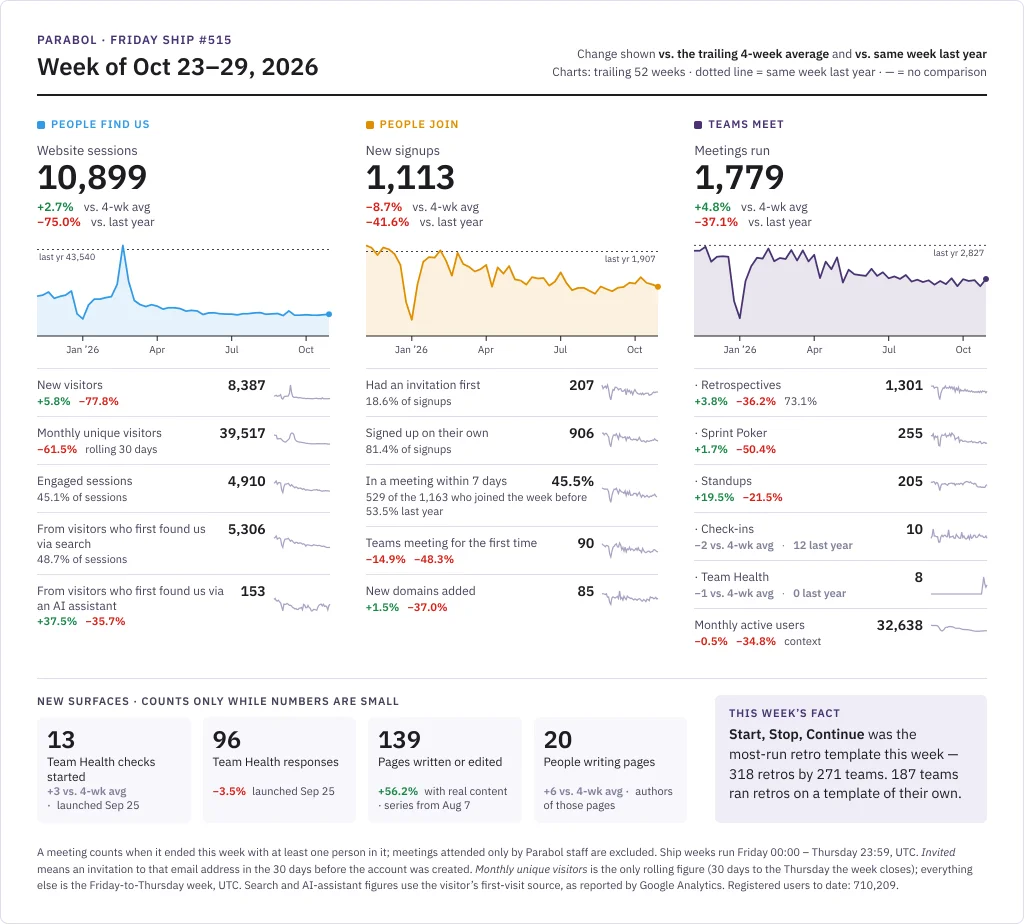
Teams ran 1,779 meetings this week, 4.8% above the four-week average, and website sessions (10,899) ticked up 2.7% (the first time in a while!), while new signups (1,113) slipped 8.7% below theirs. Stand-Ups kept climbing, up 19.5% over the four-week average, and visits from people who first found us through an AI assistant were up 37.5%. Pages had a big week too: 139 were written or edited, up 56.2%. And Start, Stop, Continue was the most-run retro template: 318 retros by 271 teams.
This week we…
…landed Reports behind a feature flag. Org admins can open a Reports page, type a question into the Ask box, and get a chart or table built from their Parabol data. We spent Friday morning poking holes in it on a staging server. The good news: it handled most questions well. The useful news: some questions quietly got a “closest” report instead of an honest “we can’t answer that yet,” so we’ll teach it what it doesn’t cover.
…shipped AI summaries for Team Health. Each Team Health category with at least three answers gets a short AI summary and a sentiment score when the check is revealed.
…made page search a lot smarter. Over four releases, search now ranks whole pages instead of fragments, shows keyword matches instantly and swaps in better ones when they’re ready, ignores filler words like “the” and “what,” and still finds a page when it only has some of your words. Questions and longer searches find the right page much more often.
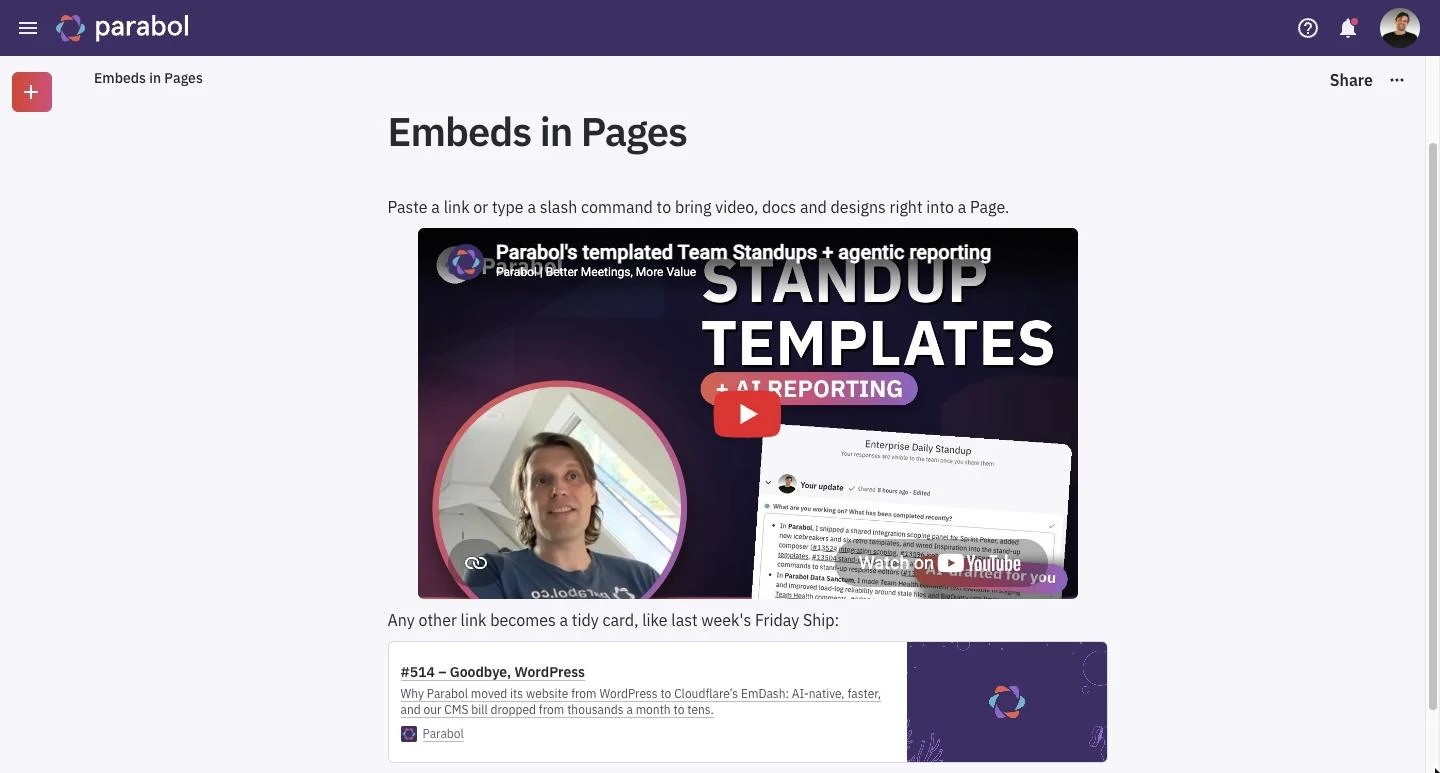
…added embeds to Pages. Type a slash command or paste a link to embed YouTube, Loom, Figma, Google Docs and more. Anything else shows up as a link card.
…fixed a stack of smaller things. Facilitators get taken to the meeting summary again after ending a meeting. Adding a task on a meeting’s task board no longer blanks the screen. Zoom transcripts now find their Parabol meeting even when the host connected Zoom from a different team. Edit Comment keeps the comment editable. Old Azure DevOps work items stay out of Standups. We also upgraded to React 19.3.
Next week we’ll…
…begin week 6 of 6 of Shape Up Cycle 16.
…keep shaping Reports for launch: faster load times, an honest “not supported yet” for questions it can’t answer, a thumbs up/down on every report, an explanation of why a Team Health cell was marked, and a pick of four default reports.
…ship better error tracking, so a browser error can be traced to the exact server request behind it.

Jordan Husney
Jordan is Parabol’s CEO and Head of Product. He was previously a Director at Undercurrent, where he advised C-Suite teams of Fortune 100 organizations on the future of work. Jordan has an engineering background, holding several patents in distributed systems and wireless technology. Jordan lives in Minneapolis, MN.