#512 – Does SaaS survive AI?
Friday Ship #512 | October 9th, 2026

This week our team discussed our company’s future, and the future of the SaaS sector generally when it is becoming increasingly easy to vibe code anything.
An individual vibe coded the full Adobe suite and released them for free, as stand-alone applications. Claude Design has quickly eroded much of Figma’s value for designing interfaces. BI dashboard builders such as Tableau and Power BI are being replaced by agentic workflows that can code custom dashboards and reports in a near instant.
The very nature of building and selling software products is changing faster than at any point since the advent of the software-as-a-service model.
We wonder, when the cost and time to building nearly anything can imagine trends toward 0, will SaaS still exist? There are a variety of opinions that seem to be trending right now.
One is Brett Queener of Bonfire Ventures The Harness, the Horse, or the Hay. He argues:
The number of applications a person uses to do their job is quickly collapsing to roughly one. If that’s right, there are only three places to stand, and many companies may be in the wrong one.
You get to pick one of three places to deliver value:
The Horse is the LLM model: enormously powerful, fundamentally unpredictable, not something you command so much as ride.
The Harness is the application layer fitted to that animal for one rider and the entire job that rider does, holding the ontology, the interaction model, and the learning loop.
The Hay is everything the horse and harness need to stay healthy at scale: orchestration, governance, cost routing, security, observability, data infrastructure.
Another post shared around our shop was the Reddit thread Serious question: What’s the point of building SaaS anymore? I found some insight in this reply:
When a company pays $49/mo for SaaS, they aren’t paying for code. They’re paying a ‘please don’t make me debug Docker containers on my birthday’ tax.
We’ve seen some attrition this year from people switching from Parabol to vibe coded tools. New accounts are still outpacing this attrition, but where is the trend headed?
By and large, people have picked off a narrow slice of what Parabol does (say, facilitate a retrospective) and are living with it. We wonder, will this trend accelerate or will the other forces (operational overhead, maintenance, lack of expert innovation) cause people to come back?
How SaaS Survives AI
We believe there are a few attributions software makers have that are robust to the accelerating risks introduced by AI:
- Network effects: software that aggregates novel human data, and where each human added adds value to the platform (examples: social networks, source code repositories, knowledge management systems)
- Bundling: becoming the one tool to rule them all. Offering the most value for the least price. (Examples: productivity suits such as ClickUp, Notion)
- Service: people still buy from people. If interacting with your company is subjectively better than interacting with an AI agent, you can win.
- Reliability: vibe coding is easier, five-nines uptime is harder
For us, this adds up to connecting and listening very carefully to our customers needs – especially about vendors they wish they could shake, and bundling that value into Parabol.
The next few years will be exciting, to say the least.
Metrics
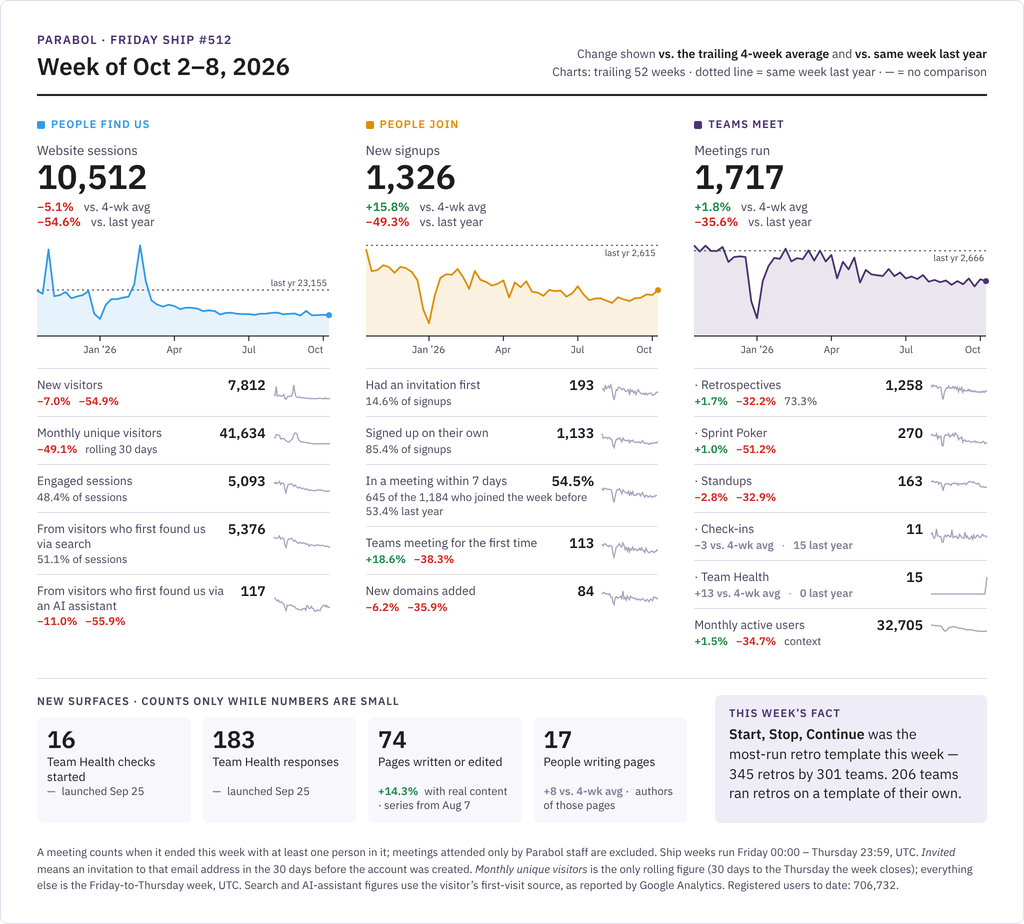
New signups were 1,326 this week, up 15.8% on the four-week average, while teams ran 1,717 meetings, 1.8% above the four-week average and 35.6% below the same week last year.
This week we…
…shipped structured Stand-Up templates. Stand-Ups now answer a template’s prompts, with one answer per prompt, and Inspirations drafts each answer from your recent work, with issue links shown as chips. We recorded a video showing off this new feature here:
…made AI the default for retro grouping. When a retro reaches the Group phase, teams with AI access now get groups suggested by AI instead of by similar wording. If the AI run fails, it falls back to similar wording.
…added six new retro templates and refreshed out our icebreaker list.
…made Parabol a lot faster to load. We moved our build to swc and started shipping a minified client. A first-time visitor now downloads 354 KB of code before the sign-in screen, down from about 2 MB. On a slow connection, sign-in is usable in 3.6 seconds instead of 12.6. We also rewrote the service worker: it caches 3.6 MB on a first visit, down from 37 MB, most of which was meeting music.
…cut our security exposure. Parabol now runs on a “distroless” base image, which has far fewer packages that could have vulnerabilities. We also did another round of dependency updates.
Next week we’ll
…begin week 3 of 6 of Shape Up Cycle 16.
…ship the rebuilt Azure DevOps integration, which now gives access per project. It’s in code review now.
…decide how to retire the optional Team Health phase inside retros now that Team Health is its own activity. One option is to link to the team’s active check instead.

Jordan Husney
Jordan is Parabol’s CEO and Head of Product. He was previously a Director at Undercurrent, where he advised C-Suite teams of Fortune 100 organizations on the future of work. Jordan has an engineering background, holding several patents in distributed systems and wireless technology. Jordan lives in Minneapolis, MN.