#508 Rethinking our SaaS Stack
Friday Ship #508 | September 11th, 2026

This week, we replaced our long-term CRM provider, HubSpot, in favor of Attio.
We wrote in Friday Ship #499 how we undertook efforts to decouple our company from HubSpot by moving its data to our data warehouse so it could be made portable. Before the widespread availability of AI Agents, this process would have taken a small teams months to execute. With AI, it took us little more than a week.
AI is quickly eroding many of the moats SaaS companies thought they could rely on, and it is heating up competition. No longer is the question, “which SaaS is the best value for the money?” the question is, “is this SaaS less expensive than what we could vibe code ourselves?”
As we migrated away from HubSpot, we found ourselves electing Attio as the team collaboration surface for our sales team. For the bits of HubSpot’s value that aren’t in Attio, we’ve found ourselves largely vibe-coding their replacements.
Durable SaaS moats in the age of AI
Of course, as a SaaS ourselves we are not immune to these same forces. It begs the question, when people have AI Agents, what SaaSs are worth paying for? We wrote about this in Friday Ship #507. What’s clear is there are still at least two moats that seem more resilient as the cost of building and operating goes down:
- Network effects: a SaaS that becomes more valuable the more people are using it, especially if the network creates data valuable to AI (examples: Reddit, LinkedIn, GitHub, etc.)
- Collaborative leverage: a place where humans and AI agents get work done together, especially for making decisions (examples: GitHub, Atlassian Jira, Notion, etc.)
Metrics
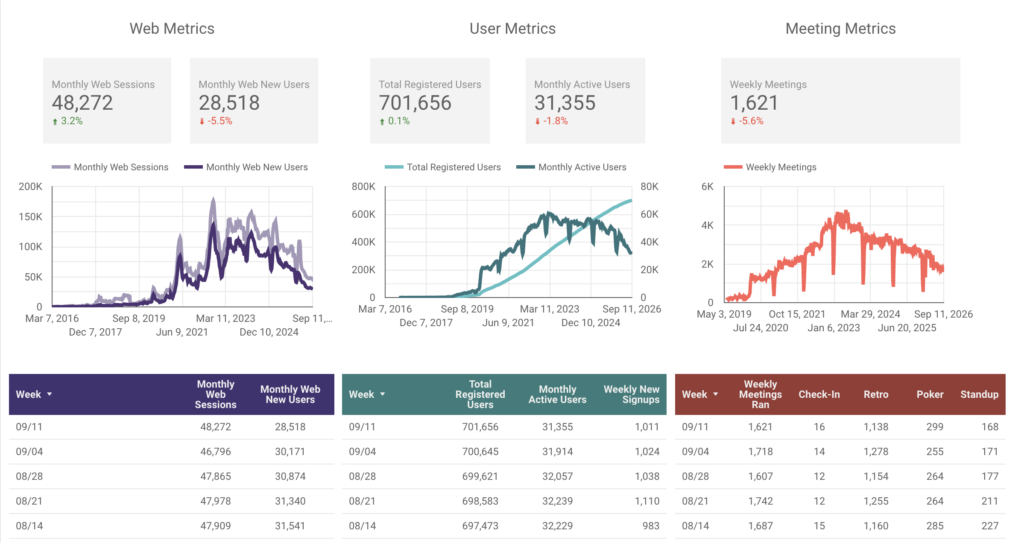
We anticipate these metrics to be the nadir of our seasonal low cycle. With the U.S. Labor Day behind us, we should record gains next week. We’ll be watching in anticipation…
This week we…
- …advanced Team Health toward launch. We reorganized results into per-category stages and added guided discussion with AI-generated paraphrasing. This one’s landing with customers: in calls this week, several long-time users told us the reporting direction is exactly what they need, and one summed up the sentiment we heard again and again, “most software I use gets worse over time; Parabol gets better.”
- …expanded our Meeting Series objects admin controls for to managing meetings across multiple teams; this work is specific to how Team Health with function.
- …began shaping structured templates for Stand-ups, landing the first backend foundation PR.
- …upgraded our rich-text editor (Tiptap) to close a security vulnerability ahead of our SOC-2 audit, and refined theme contrast for better accessibility.
- …optimized the Parabol website for AI agents. We added structured content blocks, resolved content inconsistencies across pages, and restructured and refreshed content.
Next week we’ll
- Keep driving Team Health toward release — category scores, trend views, and automated response reminders.
- Continue working on delivering embed block for Pages.
- Continue reviewing and merging code for Stand-Ups structured templates.

Jordan Husney
Jordan is Parabol’s CEO and Head of Product. He was previously a Director at Undercurrent, where he advised C-Suite teams of Fortune 100 organizations on the future of work. Jordan has an engineering background, holding several patents in distributed systems and wireless technology. Jordan lives in Minneapolis, MN.