#499 Freeing our Data
Friday Ship #499 | July 10th, 2026

This week we worked to decouple our SaaS application from our CRM, in order to give us greater flexibility about the tools we might use.
Some 7 years ago after Parabol had earned its first 10,000 registered users our attention began to shift from, “how are we going to get people to use what we’re making?” to, “how are we going to make any money with what we’ve made.” We needed to sell. To sell we needed a system that could help us generate and track our leads and guide our processes to convert these opportunities into revenue.
We elected HubSpot as our CRM. After evaluating the options at the time (we had also considered using Trello, building our own, Pipedrive, and Salesforce) we settled on HubSpot because it bundled a lot of value in one spot: it could host our website, it could give us real-time chat for prospects and customer success, email automations, and we could use it to manage our social media posting schedule, and it could give us funnel metrics and reports.
One of our first steps in being able to utilize HubSpot was to write an integration that would create HubSpot CRM records (Contacts and Companies) as people would sign up. Later we wrote code to link up their pre-signup journey in order to better understand which channels users were using to discover and evaluate using us.
Over time, however, we’ve found ourselves “unbundling” from HubSpot. The first thing to go was our website: HubSpot’s content management system (at the time) was complicated, clunky, and its serving speeds were slow. We ended up migrating to WordPress, and it was a remarkably simple, fast, and cost-effective solution. HubSpot costs, in fact, ending up playing an increasing factor: as their organization shifted from user acquisition to monetization we found our HubSpot bill kept escalating, especially as we accumulated more records there. We want to be free.
Enter the Data Sanctum
In 2022 we began building Parabol’s “Data Sanctum,” a data warehouse built on top of Google BigQuery and utilizing open-source tools such as Airbyte, DBT, and Dagster. Accumulating data to a platform we had greater control over allowed us to decide which data we really needed in HubSpot and allowed us a lot more control over our CRM costs.
Having our data in our data warehouse allows us our data to be portable, and easily shift from one CRM to another (provide both have a rich API).
(We’d previously written about the Data Sanctum in Parabol Friday Ship #422)
Further Decoupling from HubSpot
Since the creation of the Data Sanctum predated our election to use HubSpot, there is still code within the Parabol SaaS application that writes to HubSpot directly. This week, we worked on some changes that will fully decouple the Parabol SaaS from HubSpot and allow us, at least in theory, to elect tools other than HubSpot in order to further optimize costs.
Metrics
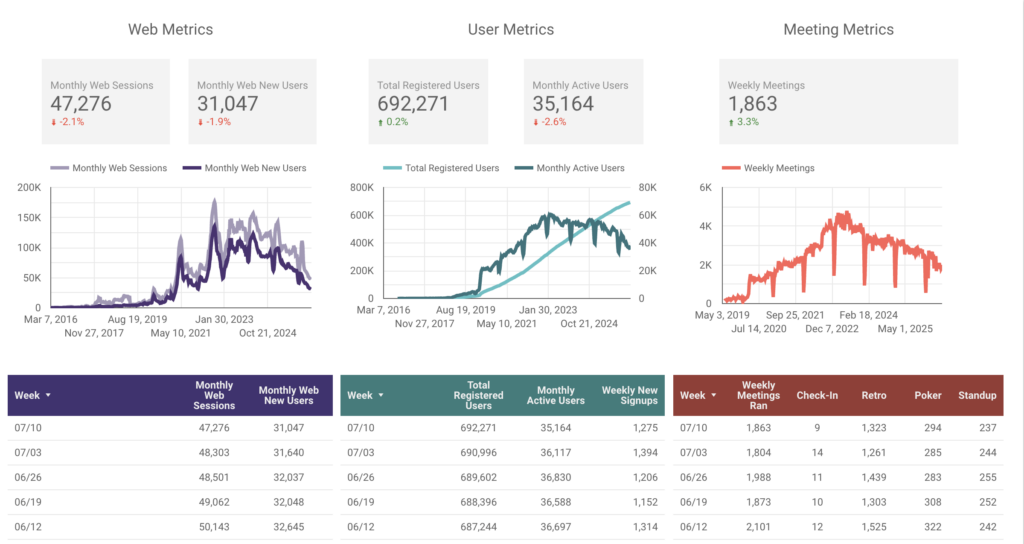
Some metrics recovery this week over the prior weeks. We saw both slight upticks in signups and platform activity.
This week we…
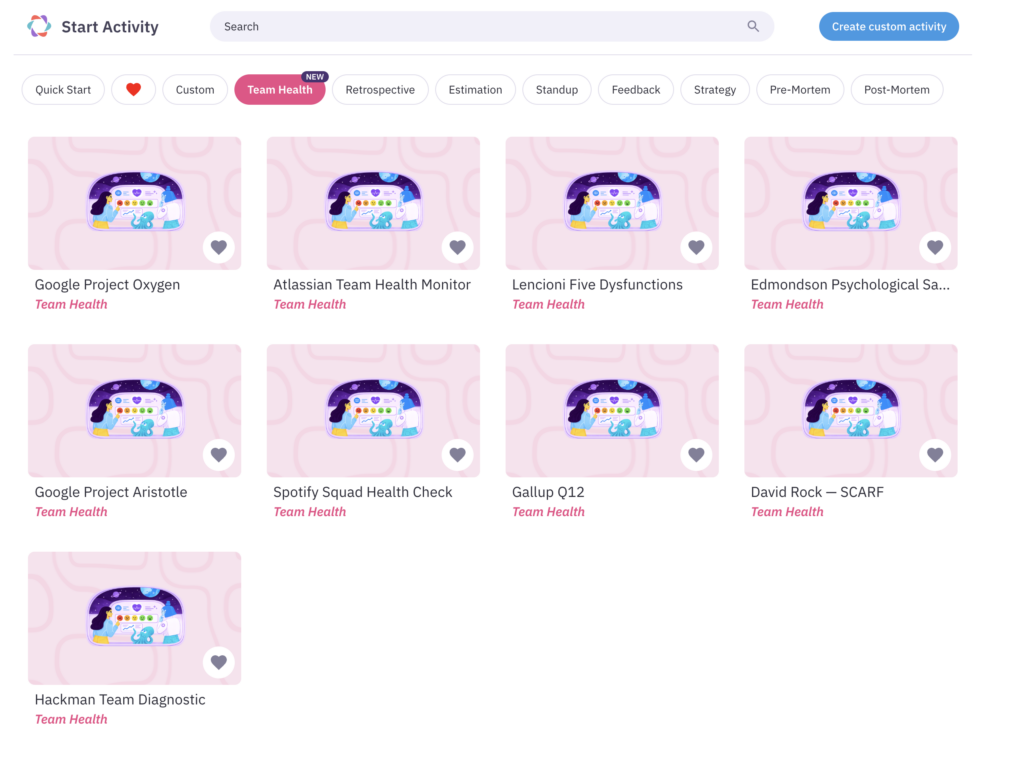
…we got started in earnest this week implementing our designs for Team Health. Here’s a snapshot from development:
…began design explorations for our next development cycle, this time looking into adding a way to build a timeline of events in a Parabol retrospective or post-mortem meeting.
Next week we’ll
…continue implementing Team Health.

Jordan Husney
Jordan is Parabol’s CEO and Head of Product. He was previously a Director at Undercurrent, where he advised C-Suite teams of Fortune 100 organizations on the future of work. Jordan has an engineering background, holding several patents in distributed systems and wireless technology. Jordan lives in Minneapolis, MN.