#494 How we do (and mostly don’t) use AI for sales and customer support
Friday Ship #494 | June 5th, 2026

They say the only sure things in life are death and taxes. As someone working in software sales and support in the year 2026, I might add another. Death, taxes, and the hyped up promise of an AI utopia for growth teams. To have the newest wave of companies tell it, I should spend my days sitting back and sipping coffee while a swarm of never-tiring agents effortlessly handle all my work, emailing customers cheery messages and smiling their million watt, too good to be true smiles.
While we’ve found some time saving uses for AI, we still think humans need to be in the drivers seat, and we never let it near our highest leverage interactions.
Where AI has Been Helpful
We’ve started experimenting with outbound sales to regulated industries that are great fits to use Parabol Pages. (e.g. companies already using Atlassian Confluence and looking for a replacement once that gets sunsetted.)
An agent developed by our team has been great at generating lists of potential customers that fit specific criteria, using open source intelligence to figure out good people to target, and then producing an email draft to be sent by a Parabol team member. We’ve had good open rates this way and have already generated meetings. It’s hard to quantify how long a human would have taken to do that work, but it’s safe to say the bot is much faster.
Basic chatbots have also been helpful with some of the more tedious work of day to day sales operations. They are especially good for doing things like taking giant lists of user identifiers from the Parabol platform and formulating them into API requests for performing back-office tasks. I copy/paste a lot less now, and I love it. Ditto with moving deals around in Hubspot. If I want to move a deal to closed/won or closed/lost, I can quickly tell our agent what to do and save myself from having to manipulate a bunch of drop downs and fields.
As for customer support, we still answer all inbound messages manually. We did recently start having an agent summarize recent interactions and share those in Slack so the broader team can stay on top of things. That has been going well.
Where AI Has Struggled
We tried to train a bot to write emails to customers who need to renew their plans. For whatever reason it really struggled with this. Despite being connected in to our data warehouse and having access to all past emails, it just couldn’t figure out how to distill the email down to what was important. The numbers they chose to cite were usually not relevant, and the emails as a whole just didn’t sound right. When we tried to get it to be more human, it would do things like make up interactions with the customer that never happened. The time it was taking to review and polish all of these was not worth it.
Our standard sales process, where we reach out to users who have surpassed our free plan and start a conversation, is a well-oiled machine at this point. AI does not have much to add that our HubSpot triggers and email templates don’t already accomplish. That doesn’t mean we won’t keep trying things, but for now it works well to have humans execute our tried and true process.
Then there are the calls themselves. We used to use call recording bots to take AI generated notes, which worked well enough, but I personally find people are more open and conversational when there is no awkward call recorder also listening in. We talk to a lot of people in regulated industries who are wary of their interactions being recorded by a third party. The benefits of AI generated call notes are not worth interfering with what is by far the most important interaction we have as a sales team.
I’m sure these models will continue to improve and we’ll keep testing ideas to make sure we are being as efficient as possible. For the meantime we remain believers in augmenting with a bit of AI while relying mostly on the power of the human touch.
Metrics
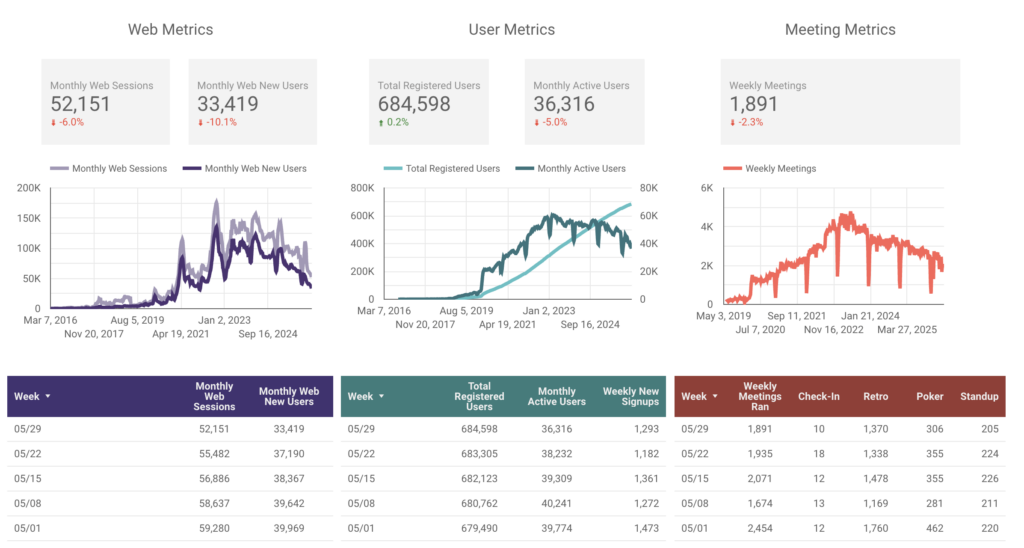
Metrics continued to fall this week – although we saw a slight rise in signups. One challenge with our metrics capture generally is as we transfer more of our SaaS user base to their own private instances, we loose visibility into their activity. We’ll need to consider how to account for that.
This week we…
…shipped our way up to v13.24.2 in production. It was a fast-moving release week—several point releases including fixes for Pages scroll behavior in dialogs and a case where creating a meeting with no teams could fail.
…did more groundwork for single-tenant and self-hosted deployments. We landed configuration changes for running Parabol’s repositories on external Docker hosts and reworked our SMTP security settings, both of which make Parabol easier to stand up inside an organization’s own walls. It’s the same thread we pulled on during cooldown, and it’s directly in service of the sovereignty conversations above.
…advanced OAuth for our Mattermost plugin. Mattermost is a favorite in self-hosted and air-gapped environments, so first-class, secure auth there matters to exactly the customers asking for private instances.
…reduced a third-party dependency by swapping our GIF provider from Tenor to Klipy, and added a Parabol label to the Jira issues we create, so work that originates in a Parabol meeting is easy to trace back.
Next week we’ll…
…keep sanding down the self-hosting experience and pick up the next Shape Up cycle, with sovereignty-friendly deployment staying near the top of the list. If you’re evaluating Parabol for a regulated or sovereign environment, we’d love to hear what you need—tell us here.

Drew Housman
Drew has spent his career helping startups grow. In previous roles he’s closed deals with Fortune 500 companies and advised on content strategy for startups. He’s an avid basketball player who used to play professionally in Israel. Drew lives in Appleton, Wisconsin with his wife, two kids, and two dogs.