The behaviors of great managers (and how to measure them)
Google Project Oxygen
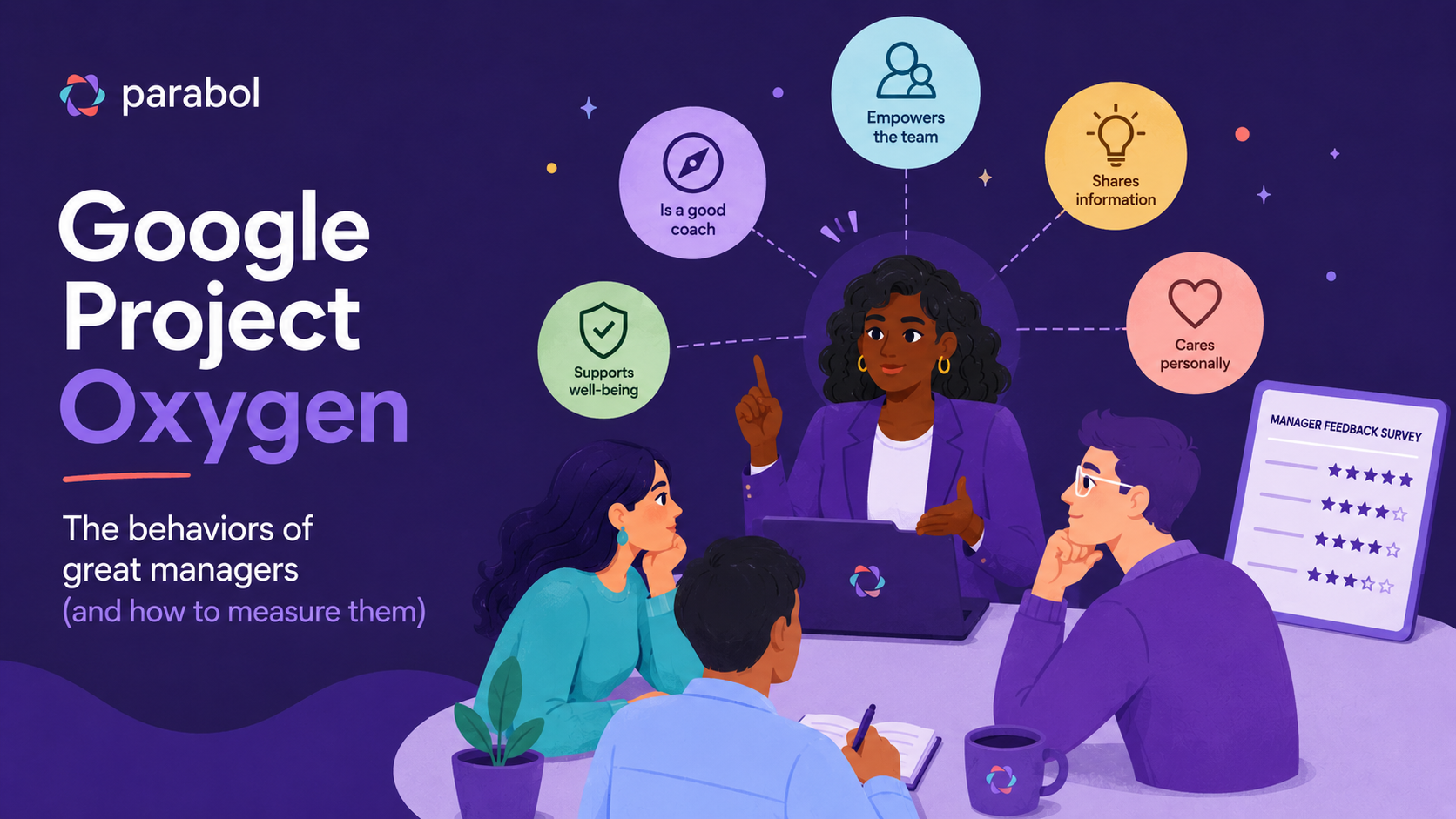
You can usually feel it when a manager is the reason a team is thriving — or the reason good people are quietly updating their resumes. But “my manager is great” or “my manager is the problem” is a hard thing to act on. It’s vague, it’s personal, and nobody wants to say it out loud in a team retro.
Google had the same problem at scale, so it did what Google does: it studied the data. The result, Project Oxygen, turned a fuzzy gut feeling into a short list of specific, learnable behaviors — and a simple survey to measure them. This page walks through where it came from, the behaviors it identified, the actual survey questions, and how to run it with your own team.
📌 Want to run something like this now? Try Parabol Health Check — measure your team in a few minutes.
What is Project Oxygen, and why use it?
Project Oxygen is Google’s research into what makes a great manager, distilled into a set of behaviors and a Manager Feedback Survey that employees use to rate their own manager. The name captures the idea: good management is like oxygen — easy to take for granted, but a team suffocates without it.
Here’s the most important thing to understand before you use it, and it’s a point of honesty worth being clear about: Project Oxygen measures the manager, not the team. Every question begins with “My manager…” The other models in the team-health world — Project Aristotle, the Five Dysfunctions, Edmondson’s psychological safety scale — ask how a team is doing as a group. Oxygen asks how one person is doing in their role.
That makes it a different unit of analysis. It’s an upward-feedback tool (feedback that flows from a team up to its manager), not a peer team-health pulse. So don’t blend Oxygen scores into a team average — you’d be mixing “how is our manager doing” with “how are we doing together,” and the two answers deserve to stand on their own.
Used for what it’s built for, it’s powerful. Manager quality is one of the strongest drivers of team health, especially psychological safety and clarity. If your team-health pulse is flashing warning signs and you want to know how much traces back to management, Oxygen is the clearest lens you’ll find — specific, behavioral, and backed by real data.
Where Project Oxygen came from
In 2008, Google’s People Operations team set out to answer a genuinely provocative question: do managers even matter?
This wasn’t an idle thought. Early on, Google had experimented with a flat, nearly manager-less organization, on the engineer-friendly hunch that managers mostly got in the way. Plenty of people there would have been happy to prove managers were dead weight.
The data said the opposite. When the analytics team dug into performance reviews, employee surveys, and other internal signals, manager quality correlated strongly with team retention, performance, and happiness. Teams with the best managers consistently outperformed teams with the worst ones. Managers didn’t just matter — they were one of the biggest levers the company had.
So the question shifted from whether managers matter to what the great ones actually do. Google studied its highest- and lowest-rated managers and reverse-engineered the difference into a list of concrete, trainable behaviors — originally eight, expanded to ten in 2018 as the company learned more. Those behaviors became the backbone of manager training and the twice-yearly Manager Feedback Survey.
The most-cited public account of all this is a 2013 Harvard Business Review article by David A. Garvin, How Google Sold Its Engineers on Management — worth reading for the full story of how a company of skeptics came around to taking management seriously.
The 10 behaviors of great managers
Google’s current list of what great managers do. A great manager:
- Is a good coach
- Empowers the team and does not micromanage
- Creates an inclusive team environment, showing concern for success and well-being
- Is productive and results-oriented
- Is a good communicator — listens and shares information
- Supports career development and discusses performance
- Has a clear vision and strategy for the team
- Has key technical skills to help advise the team
- Collaborates across the company
- Is a strong decision maker
Notice the order doesn’t imply a ranking — and notice how much of the list is about people, not technical chops. “Has key technical skills” lands at number eight. Being a good coach comes first.
What’s inside: the Manager Feedback Survey
Google measures those behaviors with a short survey it has published openly through its re:Work site. The current version has 13 items, each rated on a five-point scale from “strongly disagree” to “strongly agree.” (You may see an older 11-item version floating around online — this is the current 13-item one.)
Below we’ve organized the 13 items under Parabol’s five Team Health categories, the same five dynamics Google’s own Project Aristotle research identified: psychological safety, dependability, structure & clarity, meaning, and impact. This shows exactly how a manager’s behavior feeds into the broader health of a team.
One honest caveat about the mapping: because Oxygen measures a manager, its coverage is naturally strongest in psychological safety and structure & clarity — the areas where a manager has the most direct influence — and thinner in dependability and impact, which depend more on how teammates relate to each other. That’s expected for a manager lens, not a gap to apologize for.
Psychological safety
A great manager makes it safe to speak up, values different perspectives, and trusts people to do their jobs. These items probe whether your manager builds that kind of environment.
- My manager consistently shows consideration for me as a person.
- The actions of my manager show they value the perspective I bring to the team, even if it is different from their own.
- My manager provides the autonomy I need to do my job (i.e., does not micromanage by getting involved in details that should be handled at other levels).
- I would recommend my manager to others. (A holistic trust question — would you vouch for them?)
Dependability
For a manager, dependability is partly about competence: can the team rely on them to give sound guidance? This single item gets at whether your manager can actually advise on the work.
- My manager has the technical expertise (e.g., coding for software engineers) required to effectively manage me.
Structure & clarity
This is where managers shape a team most: setting clear goals, giving real feedback, protecting focus, sharing context from above, and making the hard calls. Oxygen covers it thoroughly.
- My manager communicates clear goals for our team.
- My manager gives me actionable feedback on a regular basis.
- My manager keeps the team focused on priorities, even when it’s difficult (e.g., declining or deprioritizing other projects).
- My manager regularly shares relevant information from their manager and senior leadership.
- My manager makes tough decisions effectively (e.g., decisions involving multiple teams or competing priorities).
Meaning
Great managers help people grow, which is one of the deepest sources of meaning at work. These two items ask whether your manager invests in your development.
- My manager assigns stretch opportunities to help me develop in my career.
- My manager has meaningful discussions with me about my career development. (Lightly adapted from Google’s time-bound original for a recurring pulse.)
Impact
A manager extends a team’s reach by working well across the wider organization. This item captures that cross-boundary contribution.
- My manager effectively collaborates across boundaries (e.g., team, organizational).
📌 Go deeper: The five categories above come straight from Google’s other landmark study. See Google Project Aristotle for the five dynamics of effective teams, and psychological safety for the research beneath the most important one.
How to run Project Oxygen with your team
Oxygen works best when you treat it as what it is — upward feedback for a manager’s growth — rather than a scorecard. A few practices keep it useful:
Make it anonymous. People will not give honest feedback about their manager if their name is attached. Anonymity isn’t a nicety here; it’s the whole ballgame. Pool responses and only share results when there are enough of them to protect individual identities (a team of three is a hard case — be thoughtful).
Keep it separate from your team-health pulse. Run your peer-to-peer team check (the Aristotle-style five dynamics) on its own, and run Oxygen as a distinct manager-feedback cycle. Mixing them muddies both signals.
Run it on a steady cadence. Google administers its survey twice a year. Two to four times a year is plenty — frequent enough to show whether changes are working, spaced enough that managers have time to actually change.
Focus on the conversation, not the score. The number is just the starting point. The real value comes when a manager reads the results, picks one or two behaviors to work on, shares that plan with the team, and follows up next cycle. A manager who openly says “you told me I don’t give enough feedback, so here’s what I’m changing” models exactly the kind of safety the survey measures.
Give managers air cover. Receiving critical feedback is hard. Frame the exercise as development, not judgment, and make sure managers’ own leaders treat it as a growth tool — not a stick.
Run a Team Health check in Parabol
Project Oxygen shows how much a manager shapes team health. Parabol’s Team Health check lets your team rate how you’re doing across five research-backed categories — psychological safety, dependability, structure & clarity, meaning, and impact — as a quick, recurring, anonymous pulse, then turns the results into a conversation.
Related models
- 📌 Google Project Aristotle — Oxygen’s sibling study. Where Oxygen measures the manager, Aristotle measures the team, through the five dynamics that became Parabol’s categories.
- 📌 Psychological safety — Amy Edmondson’s research on the single biggest driver of team performance, and the area a manager shapes most.
- 📌 Gallup Q12 — twelve questions on employee engagement, several of which (clear expectations, recognition, development) overlap with what great managers do.
- 📌 Explore all the frameworks — the full Team Health Check Tool hub.
Frequently asked questions
Is Project Oxygen a team-health survey?
Not exactly. It measures one manager’s effectiveness through upward feedback, not how a team functions as a group. It’s a strong complement to a team-health pulse — manager behavior is a major driver of team health — but it answers a different question, so keep the two separate.
How many questions are in Google’s Manager Feedback Survey?
The current version published on Google re:Work has 13 items, each rated from “strongly disagree” to “strongly agree.” An older version had 11 items; the 13-item survey is the current one.
What are the 10 behaviors of a great manager?
Being a good coach; empowering the team without micromanaging; creating an inclusive environment; being productive and results-oriented; communicating well; supporting career development; having a clear vision and strategy; having key technical skills; collaborating across the company; and being a strong decision maker. Google identified eight originally and expanded the list to ten in 2018.
How often should we run it?
Google runs it twice a year. Two to four times a year works well for most teams — often enough to track progress, with enough space between cycles for a manager to actually change a behavior.
Should manager feedback be anonymous?
Yes. Honest upward feedback depends on it. Collect responses anonymously and only share results once you have enough to protect individual identities.
Sources
- Google re:Work — The research behind great managers (the 10 behaviors)
- Google re:Work — Try Google’s Manager Feedback Survey (the 13 items)
- Harvard Business Review — David A. Garvin, How Google Sold Its Engineers on Management (2013)
- Government Executive — The 13 Questions Google Asks About Its Managers (2017)