The 12 employee questions
The Gallup Q12
Mapped to 5 simple categories to measure team health
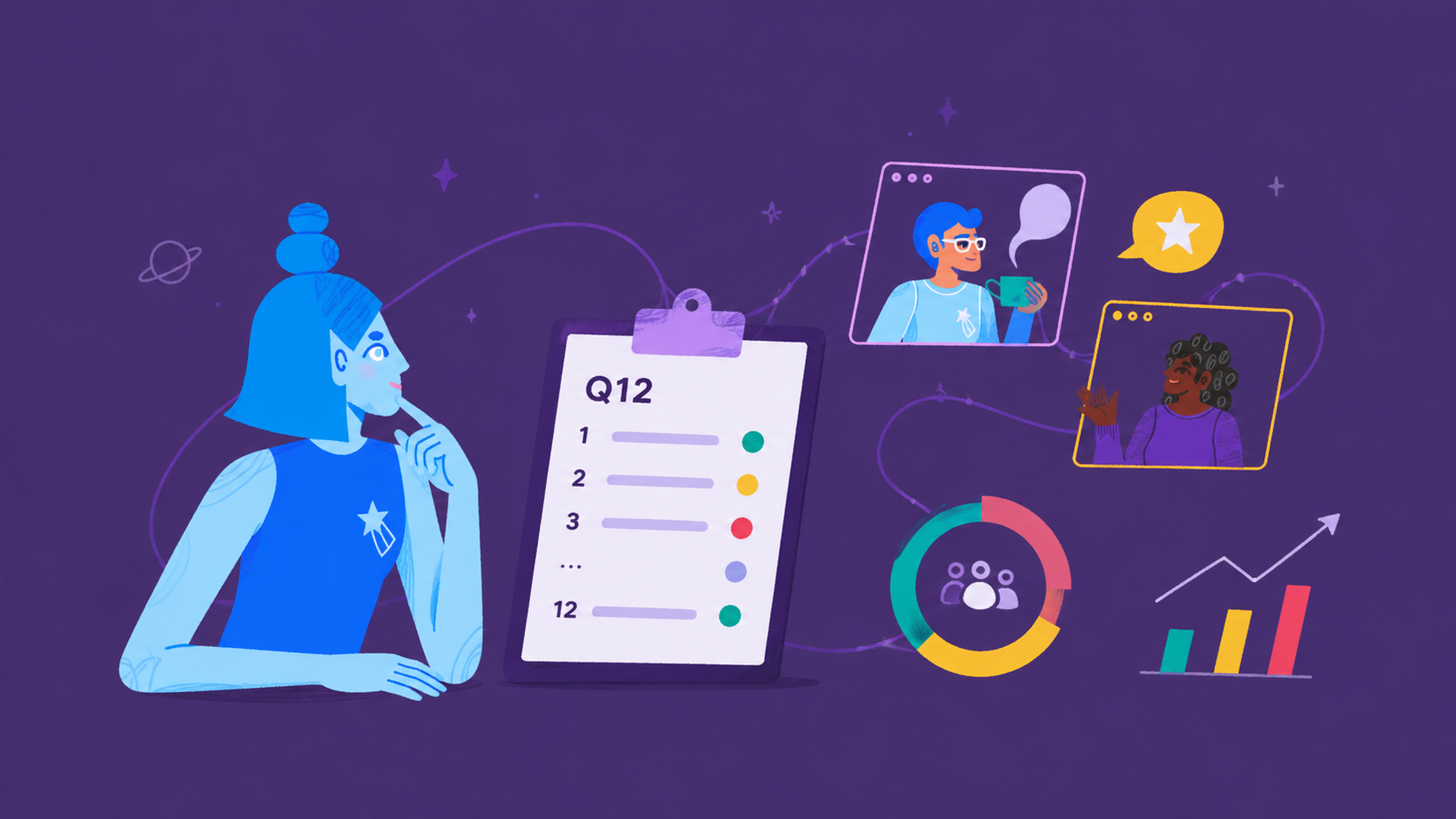
You can feel when a team has checked out. People do the work, but the spark is gone — fewer questions, flatter stand-ups, a quiet drift toward the door. “Morale is low” is easy to say and almost impossible to act on. What you need is a small set of questions that turn a vague feeling into something concrete you can measure and improve. The Gallup Q12 is one of the most tested sets of questions for exactly that — 12 short statements that predict whether people are engaged or just showing up.
📌 Want to run this now? Try Parabol Health Check — measure your team in a few minutes.
What is the Gallup Q12, and why use it?
The Gallup Q12 is a survey of 12 questions that measures employee engagement — how committed, motivated, and connected people feel at work. Gallup, the research and analytics firm best known for its polls, spent decades refining it. The “Q” stands for question, and the “12” is the number that made the final cut.
Here’s the honest caveat up front: the Q12 is an engagement instrument, and engagement is measured one person at a time. It asks how you feel about your job, your manager, and your workplace — not directly how your team functions together. So it isn’t a pure team-health survey the way some models on this site are.
But it maps onto team health remarkably well. Engagement and team health pull from the same well: when people know what’s expected, have what they need, feel cared for, and see their work matter, both their engagement and their team’s health go up. Most of the 12 questions land cleanly inside the same five categories Parabol uses for team health — psychological safety, dependability, structure and clarity, meaning, and impact. That overlap is why a leader who wants a credible, battle-tested starting point often reaches for the Q12 first.
Use the Q12 survey if you want employee engagement questions with a long research pedigree, you care about the individual experience underneath team performance, or you want a baseline you can track over time. If you want questions about how the team collaborates specifically — handoffs, decisions, conflict — pair it with a more team-focused model, which we’ll point you to at the end.
Where the Gallup Q12 came from
Most engagement surveys start with someone’s hunch about what should matter — pay, perks, a nicer office — and then ask about it. Gallup did the opposite. It started by asking millions of people what their best workplaces actually felt like, then worked backward to find the questions that predicted real results.
Over several decades, Gallup interviewed more than a million employees and managers, testing hundreds of candidate questions about what separates thriving workplaces from struggling ones. The goal was ruthless: keep only the questions that statistically predicted outcomes leaders care about — productivity, retention, customer loyalty, and profitability. Most questions didn’t survive. The dozen that did became the Q12.
The questions reached a wide audience in 1999, when Gallup researchers Marcus Buckingham and Curt Coffman published First, Break All the Rules. The book argued something that felt almost heretical at the time: people don’t leave companies, they leave managers — and the everyday basics of management (clear expectations, the right tools, a chance to do what you’re good at) matter far more to engagement than grand perks. The 12 questions were the evidence.
What’s kept the Q12 credible since then is the meta-analysis behind it. Gallup has repeatedly pooled results across thousands of business units and millions of respondents to test whether Gallup engagement scores actually predict performance — and they do. Each round of analysis links higher engagement to better outcomes: more productivity, lower turnover, fewer safety incidents, higher customer ratings, and stronger profitability. Teams in the top quartile of engagement consistently outperform the bottom quartile on those measures. Over 25 million employees have now answered the Q12 survey, which makes it one of the most-administered workplace surveys in the world — and that scale is the point. A finding that holds across millions of people in thousands of organizations is hard to wave away as a fluke.
The surprising part isn’t that engagement matters. It’s what drives it. The strongest items aren’t about money or status. They’re quiet, almost humble things: knowing what’s expected of you, having someone who encourages your growth, getting the chance to do what you do best. The Q12’s lasting lesson is that engagement is built in the ordinary texture of a job — and that’s exactly the texture a team lead can change.
A note on the name: “Q12” and “Gallup Q12” are registered to Gallup, and the official survey is its intellectual property. The questions below are adapted and team-voiced so you can use the ideas with your team. For the exact official wording, certification, or benchmarking against Gallup’s database, go straight to Gallup.
What’s inside the Q12: the 12 questions
The Q12 is short by design — 12 statements, each one a thing people either agree or disagree with. We’ve grouped the questions below under Parabol’s five team health categories so you can see exactly how an engagement survey maps onto team health. (Two of the 12 lean more toward individual engagement than team health; we flag those so you can drop them for a tighter set.)
One factual note before the list: the Q12 is administered on an agree/disagree-style scale, where stronger agreement signals a healthier, more engaged response. We’re deliberately not asserting a specific number of points or a fixed question order — common write-ups get those details wrong, so we leave the scale to you. Use whatever agree/disagree scale matches the rest of your check-in. The 12 ideas themselves are what’s well-established, and they’re sourced to Gallup.
Here’s how the questions map at a glance:
| Parabol category | What the Q12 covers here |
|---|---|
| Psychological safety | Feeling cared for, heard, and connected at work |
| Dependability | Teammates committed to quality work |
| Structure & clarity | Clear expectations, the right resources, and regular feedback |
| Meaning | Using your strengths, learning, and being recognized |
| Impact | Believing the mission makes your work matter |
Psychological safety
These three questions get at whether people feel safe, valued, and connected — the foundation everything else sits on. Psychological safety is the sense that you can speak up, ask a question, or admit a mistake without being embarrassed or punished. When people feel cared for and heard, they take those small risks; when they don’t, they go quiet.
- Someone at work — my manager or a teammate — genuinely cares about me as a person.
- My opinions seem to count at work.
- I have a real friend at work, someone I can count on.
That last one surprises people. Asking about friendship at work can feel soft, but Gallup kept it because it predicts engagement and retention so reliably. It’s really a question about belonging — whether work is a place where you have allies, not just colleagues.
Dependability
Dependability is being able to count on each other to get quality work done, rather than dropping the ball or quietly passing it along. The Q12 touches this through the standard people see around them.
- My teammates are committed to doing quality work.
When people are surrounded by others who care about doing things well, it raises their own bar and their trust in the team. When they’re not, even motivated people start to coast.
Structure & clarity
Structure and clarity means a clear understanding of what’s expected, the resources to deliver it, and feedback on how you’re doing. This is where the Q12 is strongest — and where everyday management has the biggest, fastest payoff.
- I know what’s expected of me at work.
- I have the tools and resources I need to do my work well. (Leans more toward individual engagement than team health — optional.)
- In the past six months, someone at work has talked with me about my progress.
Notice how basic these are. None of them require a budget or a reorg. Clear expectations and a real conversation about progress are within reach of almost any team lead, and they move the needle more than most perks do.
Meaning
Meaning is finding personal significance in the work — feeling that what you do uses your strengths and helps you grow. These four questions are the Q12’s emotional core.
- I get the chance to do what I do best every day.
- Over the past year, I’ve had chances to learn and grow at work.
- Someone at work encourages my development.
- In the past week, I’ve received recognition or praise for good work. (Leans more toward individual engagement than team health — optional.)
The “do what I do best” item is one of Gallup’s most powerful predictors. People who get to play to their strengths most days are far more likely to be engaged. For a team lead, that’s a practical nudge: the more you can shape roles around what each person is genuinely good at, the more engagement follows.
Impact
Impact is believing your work matters and seeing how it connects to something bigger.
- Our team’s mission or purpose makes me feel my work matters.
When people can draw a line from their daily tasks to a purpose they believe in, the work stops feeling like a treadmill. When they can’t, even good pay won’t hold them for long.
About the two optional items: the questions about tools and resources and recognition in the past week are classic engagement drivers, but they describe an individual’s experience more than the team’s shared health. If you want a tighter team-health set, drop those two and keep the other 10. If you want the full, research-backed engagement picture, keep all 12.
How to run the Q12 with your team
The questions are the easy part. Getting honest answers — and doing something with them — is where the value is. A few practical pointers:
Make it anonymous. Engagement questions touch on managers, recognition, and whether people feel cared for. People won’t answer those honestly if their name is attached. Collect responses anonymously so you get the truth, not the polite version.
Run it on a steady cadence. A single snapshot tells you where you stand today; a regular pulse tells you where you’re heading. Quarterly is a sensible rhythm for most teams — frequent enough to catch a slide early, spaced enough that it doesn’t become noise. The point of repeating it is the trend line, not the one-time score.
Keep the scale consistent. Pick one agree/disagree scale and use it every time. Changing the scale between rounds makes your trends meaningless. Consistency is what lets you say “we’ve improved on clarity since last quarter” with a straight face.
Don’t move on after one voice. When you discuss results, resist the urge to act on the first comment and call it solved. Make space to hear from more than one person on each theme — the quiet disagreement is often the one worth chasing.
Close the loop, or don’t bother. The fastest way to kill a survey is to run it and do nothing. Share the results back with the team, pick one or two themes to act on, and report what changed by the next round. People answer honestly when they’ve seen their answers lead somewhere.
A scored, anonymous check-in plus a structured conversation is the whole job. You can run that on paper, in a spreadsheet, or in a tool built for it.
Run a Team Health check in Parabol
The Q12’s focus on engagement informs how we think about team health. Parabol’s Team Health check lets your team rate how you’re doing across five research-backed categories — psychological safety, dependability, structure & clarity, meaning, and impact — as a quick, recurring, anonymous pulse, then turns the results into a conversation.
Related models
The Q12 is a strong engagement baseline. To round out the team side of the picture, these models pair well with it:
📌 Google Project Aristotle — the study behind Parabol’s five categories. Where the Q12 measures individual engagement, Aristotle measures what makes a team effective. Start here if you want the team-collaboration view the Q12 doesn’t fully cover.
📌 Psychological safety (Amy Edmondson) — a deeper look at the single biggest driver of team performance. A natural next step if the Q12’s “my opinions count” item lands close to home.
📌 Google Project Oxygen — what great managers actually do. Since so many Q12 items hinge on the manager (clear expectations, encouragement, recognition), Oxygen is the practical companion for the people who set those conditions.
You can find all of these on the Team Health Check Tool hub.
Frequently asked questions
What is the Gallup Q12?
The Gallup Q12 is a 12-question survey that measures employee engagement — how committed, motivated, and connected people feel at work. Gallup developed it over decades by testing hundreds of questions against real business outcomes and keeping only the 12 that best predicted results like productivity, retention, and profitability.
Is the Q12 a team health survey?
Not strictly. It’s an engagement survey, measured one person at a time. But its questions map cleanly onto team health — covering clarity, recognition, growth, and feeling cared for — which is why it’s a popular starting point for leaders who want a research-backed pulse on their team. For questions about collaboration specifically, pair it with a team-effectiveness model like Project Aristotle.
What scale does the Q12 use?
It’s administered on an agree/disagree-style scale, where stronger agreement signals a healthier, more engaged response. We don’t assert a specific number of points here, because popular write-ups often get that detail wrong — use whatever agree/disagree scale matches the rest of your check-in, and keep it consistent over time.
Can I use the Q12 questions for free?
The official Q12 is Gallup’s intellectual property, and “Q12” is a registered Gallup trademark. The questions on this page are adapted and team-voiced so you can work with the ideas. For the official wording, certification, or benchmarking against Gallup’s database, go to Gallup directly.
How often should we run it?
Quarterly works for most teams — frequent enough to catch problems early, spaced enough to show a real trend without survey fatigue. What matters most is consistency: same questions, same scale, and a visible follow-up each time so people see their answers lead to change.
Source: Gallup — The Gallup Q12 Employee Engagement Survey. Background: UC Irvine HR — Q12 FAQ.