The five dynamics of effective teams
Google Project Aristotle
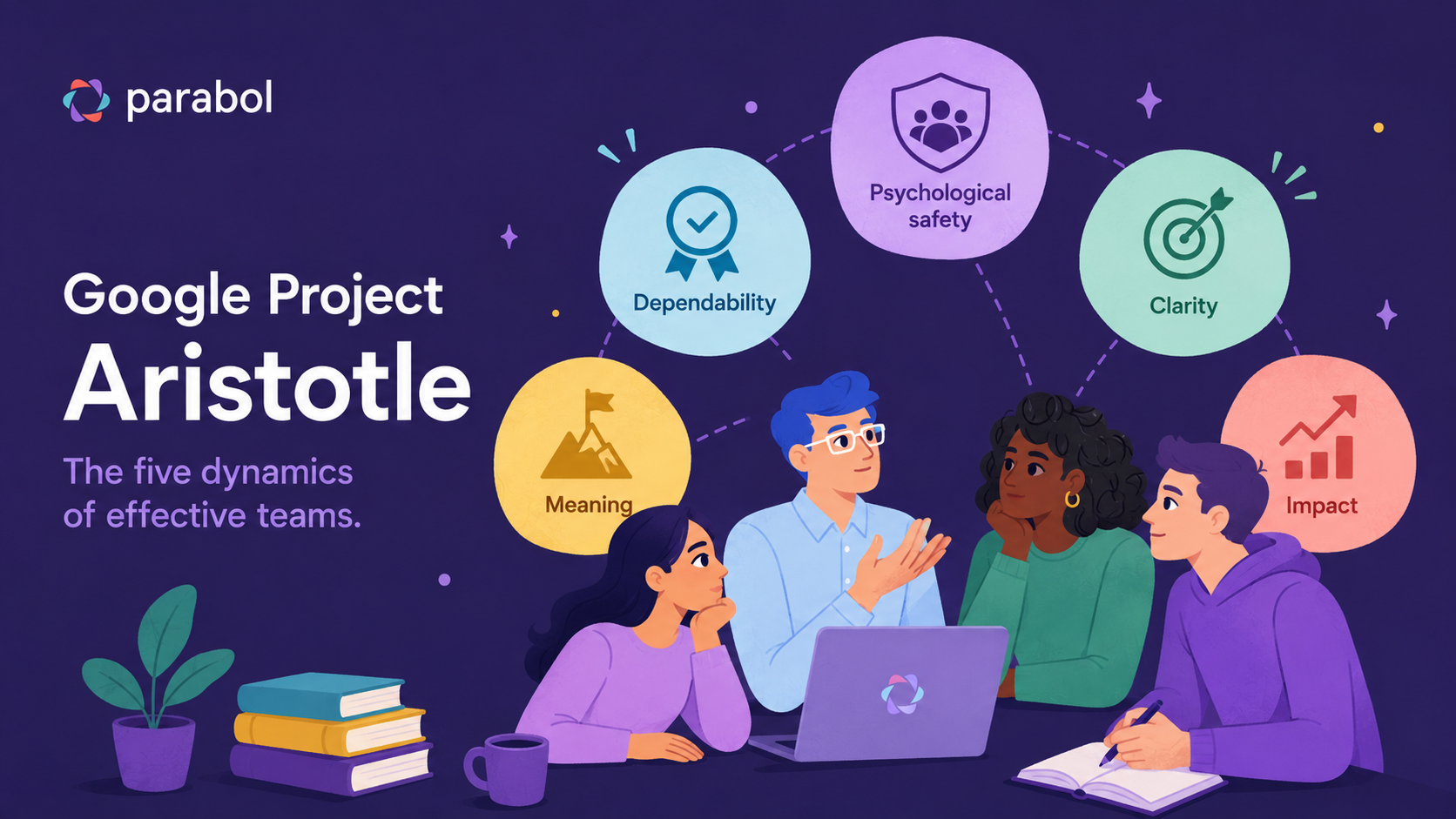
You can usually feel when a team is struggling. The energy in meetings dips, work slips through the cracks, and people stop saying what they really think. But “I feel like morale is low” is a hard thing to act on. You can’t fix a feeling, and you can’t improve what you can’t name.
That’s the gap Google Project Aristotle set out to close. Google’s researchers wanted to know exactly what separates great teams from mediocre ones, and the answer they found gives you something concrete to measure and improve. This page walks through that answer: where the study came from, the five dynamics it uncovered, the real survey questions behind each one, and how to run them with your own team.
📌 Want to run this now? Try Parabol Health Check — measure the five dynamics with your team in a few minutes.
What is Google Project Aristotle, and why use it?
Google Project Aristotle was a multi-year research effort by Google’s People Analytics team to figure out what makes a team effective. After studying scores of its own teams, Google landed on five things — the five dynamics of effective teams — that consistently set high-performing teams apart from the rest.
Here’s the part that surprised even Google: the five dynamics have almost nothing to do with who is on the team. They’re all about how the team works together. You don’t need to hire a roster of stars. You need to build the conditions where an ordinary group of people can do their best work.
That makes Aristotle a practical tool, not just an interesting study. The five dynamics give you a shared vocabulary for something that usually stays vague. Instead of “morale feels low,” you can ask: Is it safety? Dependability? Clarity? Meaning? Impact? Each one points to a different fix.
It’s a good fit if you lead or coach a team — as an engineering manager, Scrum Master, agile coach, or people-ops practitioner — and you want a credible, low-effort way to take your team’s pulse. It works for any team, not just software teams. The five dynamics are human, not technical.
And there’s a reason this model sits at the center of how Parabol thinks about team health: Parabol’s five Team Health categories are Aristotle’s five dynamics. More on that mapping below — it’s a 1:1 match, which makes this the natural home base for everything else.
Where Google Project Aristotle came from
In 2012, Google had a long-running argument on its hands. Build a team of the very best individuals and you’ll get the best team, one camp said. Nonsense, said the other — it’s all about chemistry and how people gel. Both sides were sure they were right. Neither could prove it.
So Google did what Google does: it turned the question into data. Its People Analytics group launched a study and named it Project Aristotle, a nod to the idea that the whole of a team can be greater than the sum of its parts. Over roughly two years, the team studied more than 180 Google teams, interviewing people and analyzing how those teams worked and performed.
At first, the data refused to cooperate. The researchers looked for patterns in who made up the best teams: their skills, their personalities, their seniority, even how often they socialized outside work. Nothing held up. Teams with similar people performed wildly differently. The “right mix of people” theory fell apart.
The breakthrough came when they stopped asking who and started asking how. Once they looked at group norms, the unwritten rules for how people treat each other, the picture snapped into focus. Five dynamics kept separating the strong teams from the weak ones. And one of them mattered far more than the rest.
That one was psychological safety: the shared sense that you can take a risk, ask a “dumb” question, or admit a mistake without being made to feel small. Google called it “by far the most important” of the five. The term itself comes from Harvard’s Amy Edmondson, whose 1999 study of 51 teams gave the concept its research foundation — and whose work is worth a read in its own right (see psychological safety below).
Google published the full findings on its re:Work site, where it shared people-analytics research with the world: the definitions, the rankings, and sample survey questions. The five dynamics quickly became some of the most cited ideas in modern team management, and they’re the reason “psychological safety” went from an academic term to a phrase you’ll now hear in boardrooms.
There’s a quietly hopeful message buried in all this. If great teams came down to hiring the right stars, most of us would be stuck with the team we happen to have. But the five dynamics are about behavior and norms, and those can be changed. You can make it safer to speak up. You can tighten how decisions get made. You can help people see the impact of their work. In other words, the thing that most predicts whether your team thrives is also the thing most within your control.
A note on sources: Google has since archived its re:Work site, so some original links may move over time. The findings remain accurate and are widely mirrored. We link to the primary sources at the end of this page.
What’s inside Google Project Aristotle: the five dynamics
Google ranked the five dynamics in order of how strongly they predicted team effectiveness. The order matters: the dynamics build on each other, and psychological safety is the foundation the rest stand on.
Here’s the model at a glance — and because Parabol’s five Team Health categories are these exact five dynamics, the mapping is one-to-one.
| Rank | Aristotle dynamic | Parabol category | In plain terms |
|---|---|---|---|
| 1 | Psychological safety | Psychological safety | Can I take a risk here without feeling embarrassed or punished? |
| 2 | Dependability | Dependability | Can we count on each other to deliver quality work on time? |
| 3 | Structure & clarity | Structure & clarity | Do I know the goals, my role, and how we make decisions? |
| 4 | Meaning | Meaning | Does this work matter to me personally? |
| 5 | Impact | Impact | Do I believe the work we do makes a difference? |
The questions below come from Google’s own published survey, where each dynamic had a validated sample statement (marked as Google’s verbatim wording), plus a few faithful variants we’ve added to round out each set. Everyone answers on a simple agree-to-disagree scale, and every statement is phrased so that agreeing always means healthier. That keeps your results easy to read at a glance.
1. Psychological safety
This is the foundation, and the single biggest predictor Google found. Psychological safety is the shared belief that your team is a safe place to take an interpersonal risk — to ask a question, float a half-formed idea, disagree with the boss, or own up to a mistake. When it’s high, problems surface early. When it’s low, people go quiet and small issues grow in the dark.
- If I make a mistake on this team, it is not held against me. (Google’s sample item)
- I feel safe to take risks and be vulnerable in front of my teammates.
- I can raise problems and tough issues with this team.
2. Dependability
Safety gets people talking; dependability gets the work done. This dynamic is about trust in the everyday sense: when a teammate commits to something, it actually happens, and to a standard you can rely on. Low dependability is corrosive because the people who do follow through end up quietly carrying those who don’t.
- When my teammates say they’ll do something, they follow through with it. (Google’s sample item)
- I can count on my teammates to deliver quality work on time.
- Everyone on this team pulls their weight.
3. Structure & clarity
Even a safe, reliable team stalls if no one’s sure where they’re headed. Structure and clarity means people understand the goals, know what’s expected of them, grasp how their role fits with everyone else’s, and trust that decisions actually get made. Without it, effort scatters and the same debates repeat on a loop.
- Our team has an effective decision-making process. (Google’s sample item)
- I know what’s expected of me, and the goals for my work are clear.
- I understand my role and how it fits with my teammates’ roles.
4. Meaning
The first three dynamics are about how the team functions. The last two are about why the work is worth doing. Meaning is personal: it’s the sense that the work matters to you, whether that comes from the work itself, the people you do it with, or what it lets you build toward. People can endure a lot when the work means something, and burn out fast when it doesn’t.
- The work I do for our team is meaningful to me. (Google’s sample item)
- I find a sense of personal purpose in my work.
5. Impact
Meaning is about the work feeling significant to you; impact is about believing it actually makes a difference. Can people see how their work connects to the team’s goals and the wider organization’s? When that line of sight is clear, effort feels worthwhile. When it’s missing, even busy teams start to wonder if any of it lands.
- I understand how our team’s work contributes to the organization’s goals. (Google’s sample item)
- I can see the difference our team’s work makes.
Questions adapted from Google re:Work’s published sample items for the five dynamics. Google’s validated sample statement for each dynamic is flagged; the remaining variants stay faithful to re:Work’s published definitions.
How to run Google Project Aristotle with your team
You don’t need a license, a consultant, or a Google-sized research budget to use this model. You need a regular, honest conversation, structured around the five dynamics. Here’s a simple way to do it.
Start with one question per dynamic. Five questions — one for each category — is plenty for a first pulse. It takes a couple of minutes to answer and keeps the focus on the conversation, not the survey. You can always add the variants above as you go deeper.
Make it anonymous, especially early on. This is the catch-22 of measuring psychological safety: people won’t tell you the team feels unsafe unless they feel safe telling you. Anonymous, aggregated responses lower the stakes and surface the honest signal. As trust grows, some teams open up to attributed responses — but never force it.
Run it on a steady cadence. A team’s health is a moving target, so check it like a vital sign, not a one-off audit. Many teams fold a quick pulse into an existing ritual, like the start of a sprint retrospective or a monthly check-in. Regular beats thorough. Trends over time tell you far more than any single score.
Discuss the results — don’t just collect them. The number isn’t the point; the conversation it starts is. Share the aggregated results with the team and ask the obvious question: “Does this match how it feels?” The discussion is where the real insight lives, and it signals that you’re measuring this to act, not to grade people.
Work on your lowest dynamic first — and weight safety. Pick the one or two dynamics scoring lowest and agree on a single, concrete experiment to try before the next check. And remember Google’s ranking: psychological safety is the foundation. If it’s shaky, shore that up first, because it’s hard to improve dependability, clarity, or anything else on a team where people don’t feel safe to be honest.
Run a Team Health check in Parabol
Project Aristotle’s five dynamics are the very categories Parabol’s Team Health check is built on. Parabol’s Team Health check lets your team rate how you’re doing across five research-backed categories — psychological safety, dependability, structure & clarity, meaning, and impact — as a quick, recurring, anonymous pulse, then turns the results into a conversation.
Related models
Aristotle is the map. These related models go deeper on specific territory — and each maps onto the same five Parabol categories, so they fit together cleanly.
📌 Go deeper on the #1 dynamic: Psychological safety (Amy Edmondson) — the Harvard research that gave Aristotle’s most important dynamic its foundation, with a validated survey you can use.
📌 Set teams up to succeed: Team Diagnostic Survey (Hackman) — a research-backed look at the “enabling conditions” that make teams effective before the work even starts.
📌 Measure the manager’s effect: Google Project Oxygen — Aristotle’s sister study, on what great managers actually do and how it shapes team health.
Want the full set? Browse every framework on the Team Health Check Tool hub.
Frequently asked questions
What are the five dynamics of effective teams?
They are, in Google’s ranked order: psychological safety, dependability, structure and clarity, meaning, and impact. Psychological safety is the foundation. Google called it “by far the most important” of the five.
Is Project Aristotle the same as psychological safety?
No, but they’re closely linked. Psychological safety is just one of Aristotle’s five dynamics, the top-ranked one. Google didn’t invent the concept; it borrowed it from Harvard researcher Amy Edmondson and showed, with its own data, how much it matters for team effectiveness.
Are these the real Google survey questions?
The flagged statement under each dynamic is Google’s own published sample item from its re:Work research. The additional variants are faithful rewordings that stay true to Google’s published definitions, so you have more than one question per category to work with.
How is this different from an employee engagement survey?
Engagement surveys usually measure how individuals feel about their job and the company. Aristotle measures how a team works together. The unit is the team, not the person, which is why the questions ask about “us” and “my teammates,” not just “me.”
How often should we run it?
Often enough to spot trends. Many teams run a short pulse every sprint or every month, folded into an existing ritual like a retrospective. The exact cadence matters less than consistency. A steady rhythm beats an occasional deep dive.
Primary sources
- Google re:Work — Understand team effectiveness: https://rework.withgoogle.com/intl/en/guides/understand-team-effectiveness
- Google — The five dynamics of an effective team: https://business.google.com/us/think/future-of-marketing/five-dynamics-effective-team/