#489 Parenting
Friday Ship #489 | May 1st, 2026

This week demands from work were high, while demands on me as a parent were higher.
It was my 46th birthday this week. My wife baked a beautiful cake. Friends came over, we shared a meal, I blew out the candles. By most measures, a celebration. But this week didn’t feel much like one. My daughter had been sick since the week before, a virus that wouldn’t let go, a spiking fever, and many days home from school. Layered underneath all of it: a particularly urgent stretch at work, calls I needed to find time for, things that couldn’t wait. I was stepping outside the doctor’s office to take a call. Trying to be fully present in two places at once, which of course means being fully present in neither.
This isn’t a unique experience. The U.S. now has an estimated 63 million family caregivers, a number that has grown 45% in just the last decade. Almost one in four working adults is caring for someone: a child, a parent, a partner, a sibling. And yet in a 2024 study, 37% of working caregivers said they were afraid to even raise their caregiving responsibilities at work. We all carry this. We mostly carry it quietly.
Nearly 11 years into Parabol, I’ve watched so many employees start as digital nomads, figure out where they want to live,, fall in love, buy a house, and start a family. It’s one thing to build products. It’s another thing entirely to build lives. I’ve feel lucky to have seen it. To play a small part in it. But I’ve also watched those same people try to diagnose a crash during a nap window, or patch a security vulnerability while their toddler is sick on the couch next to them. And I know that for many of them, the time is coming, or has already come, when they’ll be navigating an aging parent’s healthcare on top of everything else. The work doesn’t stop because the rest of life is happening.
A Better Way
We’re in the middle of a significant rethinking of how work gets done. AI is reshaping what jobs look like, what gets automated, where human attention is actually needed. I hope that in the middle of that rethinking, we also find room to reconsider this. The evidence suggests it’s possible: a large trial in Iceland found that shifting to a four-day work week didn’t just maintain productivity, it measurable redistributed who was doing the caregiving at home. Men in the trial reported meaningfully more participation in household labor and childcare. The structural change didn’t just help caregivers cope; it began to change who was caregiving in the first place. I don’t know exactly what the right answers look like for every organization but I do think the conversation is worth having at work and in society. Especially now, in this moment, where we have an opportunity to recapture productivity to serve our lives.
Metrics
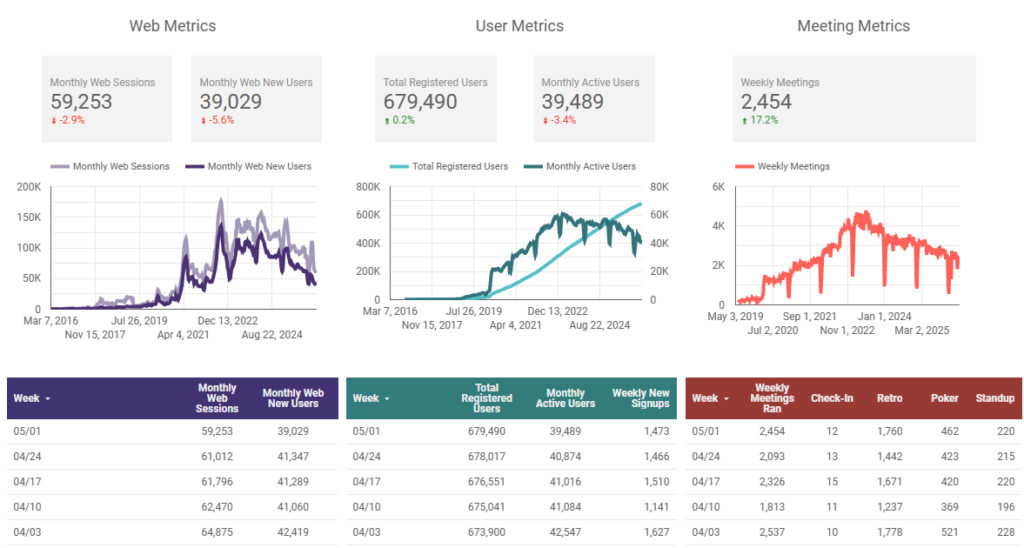
Weekly meetings rebounded this week meaningfully. We theorize the continued downtrend in web metrics are the effects of AI while the downtrend in MAU is attributed to increased monetization. We’re watching closely!
This week we…
…completed an internal product milestone reaching feature complete for our first Public API. We have a bit more testing and refinement to do before reaching production, but we’re eager to release this major new feature and share with the world what can be done with it!
Next week we’ll
…share a demo of our our Public API works.

Jordan Husney
Jordan leads Parabol’s business development strategy and engineering practice. He was previously a Director at Undercurrent, where he advised C-Suite teams of Fortune 100 organizations on the future of work. Jordan has an engineering background, holding several patents in distributed systems and wireless technology. Jordan lives and works in Los Angeles, CA.