How five social drivers shape team health
The SCARF Model
A teammate gets cut out of a decision they expected to be part of. Someone’s idea gets shot down in a meeting. A reorg lands with no warning. None of these cost anyone a paycheck — and yet people stew on them for days.
Here’s the unsettling part: your brain barely tells the difference between those moments and a physical threat. That’s the insight at the heart of the SCARF model. The same circuitry that flinches from danger also flinches from being sidelined, judged, or blindsided. When that alarm fires, people get defensive, go quiet, or quietly check out — and your team’s performance goes with them.
The SCARF model is a map of the five social triggers behind that response. Learn them, and a lot of “low morale” suddenly has a cause you can actually do something about.
📌 Want to run this with your team now? Try Parabol Health Check — measure your team in a few minutes.
What is the SCARF model, and why use it?
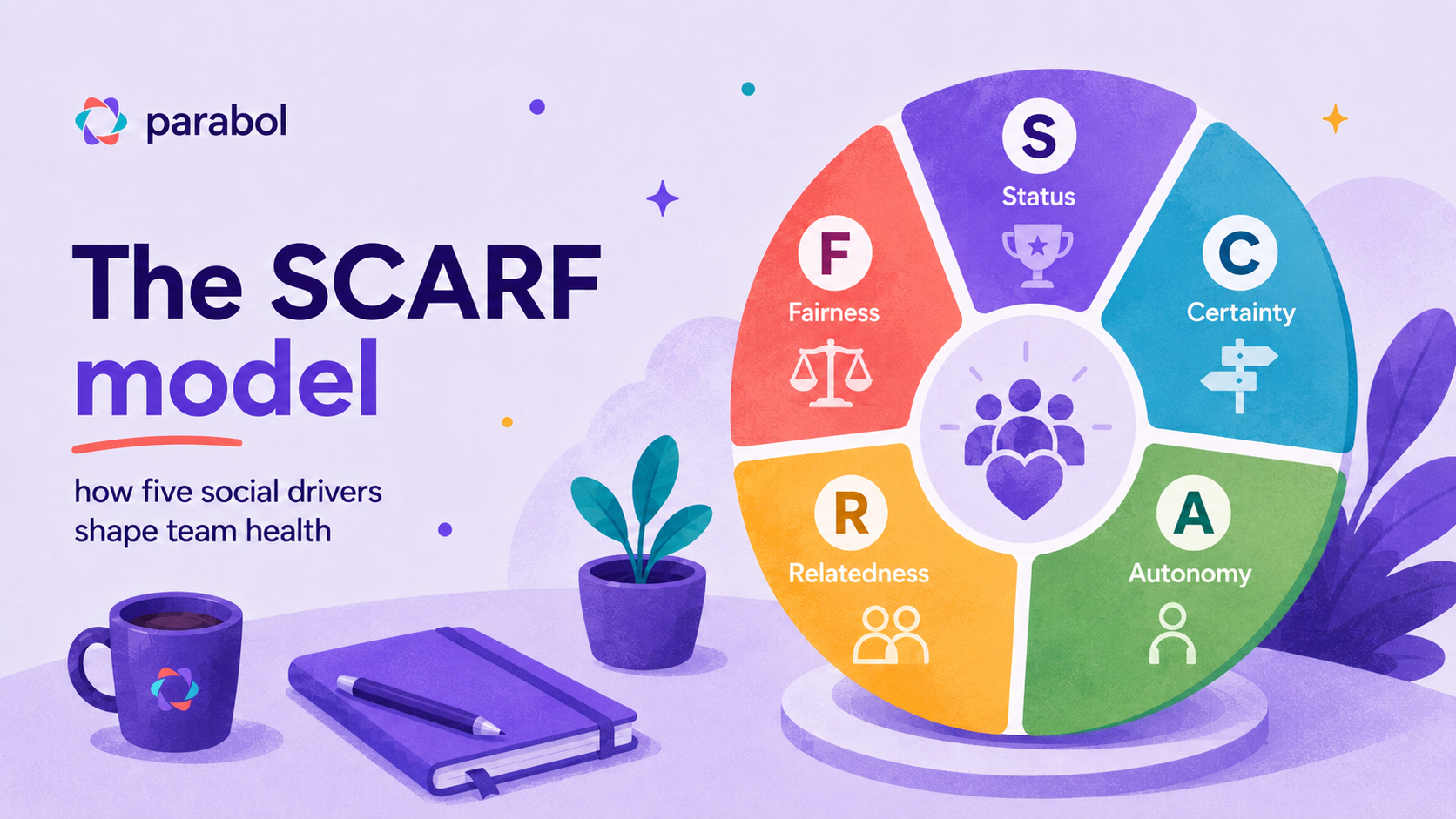
The SCARF model is a framework that names the five things our brains care most about in social situations: Status, Certainty, Autonomy, Relatedness, and Fairness. When any one of them is threatened, people move into a defensive, threat state. When any one is rewarded, people move toward a more open, collaborative state.
It was created by David Rock, a thinker who helped popularize the field of “NeuroLeadership” — the idea of using brain science to lead people better. SCARF takes a pile of social-neuroscience research and turns it into something a busy team lead can actually remember and use.
That’s the real value of SCARF: it gives you a vocabulary for the invisible stuff. Most friction on a team isn’t about the work itself. It’s about someone feeling overlooked (Status), kept in the dark (Certainty), micromanaged (Autonomy), excluded (Relatedness), or treated unfairly (Fairness). SCARF lets you point at the exact driver instead of waving vaguely at “a culture problem.”
It’s a good fit if you’re a team lead, Scrum Master, manager, or coach who keeps sensing that something is off between people but can’t name it. SCARF is less a scorecard and more a lens — a way to understand why psychological safety and clear expectations matter so much, and where yours might be quietly leaking.
One honest caveat up front, because it shapes how you should use this page: there is no official SCARF questionnaire. Rock’s model is well-sourced, but he never published a survey to go with it. We’ll come back to what that means for the questions below.
Where the SCARF model came from
David Rock published SCARF in 2008, in the very first issue of the NeuroLeadership Journal. The paper’s title says what he was after: “SCARF: a brain-based model for collaborating with and influencing others.”
His starting point was a finding that still surprises people. Across a wave of social-neuroscience studies, researchers kept seeing that the brain handles social experience much like it handles physical survival. As Rock put it, “social needs are treated in much the same way in the brain as the need for food and water.” Being left out or put down doesn’t just feel bad in a fuzzy, emotional sense — it lights up threat circuitry in a way that’s startlingly close to physical pain.
Rock paired that with a second idea: the brain is running a constant, low-level calculation to minimize threat and maximize reward. We’re wired to move away from danger and toward safety, faster than we consciously think. In social life, that “away or toward” reflex is firing all day long — in every meeting, every piece of feedback, every decision made without you in the room.
The leap Rock made was to ask: what, specifically, sets off that social threat-or-reward response at work? He landed on five domains. Here are his own definitions, word for word from the 2008 paper:
“Status is about relative importance to others. Certainty concerns being able to predict the future. Autonomy provides a sense of control over events. Relatedness is a sense of safety with others, of friend rather than foe. And fairness is a perception of fair exchanges between people.”
Those five initials spell SCARF. It’s a tidy bit of branding, but the point underneath is serious: each domain is a lever. Threaten it and people contract; reward it and they open up. A manager who understands this can defuse a conflict, deliver hard news, or run a reorg in a way that keeps people in a “toward” state instead of triggering the alarm.
That’s why SCARF caught on with coaches and people leaders. It’s one of the few team frameworks that tries to explain the mechanism — not just “psychological safety is good,” but a plausible account of why a single careless comment can wreck a week.
What’s inside the SCARF model
At the center of SCARF are the five domains — Status, Certainty, Autonomy, Relatedness, and Fairness. Here’s what each one means in plain team terms.
- Status — your sense of relative importance. Status takes a hit when you’re talked over, corrected in public, or passed up for recognition. It rises when your contribution is genuinely seen.
- Certainty — your ability to predict what’s coming. Ambiguity, surprise changes, and unclear expectations all read as threat. Clear plans and honest heads-ups read as safety.
- Autonomy — your sense of control over your own work. Micromanagement is an autonomy threat. Trust and real choices are an autonomy reward.
- Relatedness — your sense of being among friends, not foes. New teams, remote distance, and cliques erode it. Belonging and trust restore it.
- Fairness — your read on whether exchanges are fair. Uneven workloads, inconsistent rules, and opaque decisions all sting here, even when nothing else is wrong.
How SCARF maps onto Parabol’s five categories
Parabol’s Team Health tool organizes everything around five categories — Psychological safety, Dependability, Structure & clarity, Meaning, and Impact. (They’re the same five dynamics Google’s Project Aristotle found in effective teams.) SCARF’s five domains don’t line up one-to-one with those categories — they pool into three of them.
| SCARF domain | What it means (Rock, 2008) | Parabol category |
|---|---|---|
| Status | Relative importance to others | Psychological safety (safe feedback) · Meaning (recognition) |
| Certainty | Being able to predict the future | Structure & clarity |
| Autonomy | A sense of control over events | Meaning |
| Relatedness | A sense of safety with others, friend rather than foe | Psychological safety |
| Fairness | A perception of fair exchanges | Psychological safety · Structure & clarity (fair process) |
Worth saying plainly: SCARF is concentrated, not comprehensive. It has a lot to say about Psychological safety, Structure & clarity, and Meaning — and almost nothing to say about Dependability (do we follow through for each other?) or Impact (does our work matter to the wider goal?). That’s not a flaw in SCARF; it was built to explain social threat and reward, not delivery. It just means SCARF works best paired with a results-focused model like Project Aristotle or the Five Dysfunctions of a Team when you want full coverage.
SCARF model examples: questions to probe each domain
Now the honest part we promised. SCARF has no published, official questionnaire. The NeuroLeadership Institute sells a proprietary “SCARF Assessment,” but its items aren’t public, and Rock’s original paper contains no survey at all.
So the questions below are authored by Parabol. We wrote them to probe each of Rock’s domains, grounded in his own verbatim definitions above. Treat them as illustrative SCARF model examples — a faithful starting point for a conversation — not as a validated instrument. They’re agree/disagree statements, written so that agreeing always points to a healthier team. Group them under Parabol’s categories like this.
Psychological safety (Relatedness, the safe side of Status, and Fairness). These probe whether people feel like friends rather than foes, can take feedback without feeling diminished, and trust that the basics are shared out fairly. When these slip, you’ll see silence and self-protection long before anyone says a word.
- I feel a real sense of belonging and trust with my teammates. (Relatedness)
- I can be myself around the people I work with. (Relatedness)
- I can give and receive feedback here without feeling diminished. (Status)
- Recognition, workload, and opportunities are distributed fairly on our team. (Fairness)
Structure & clarity (Certainty, and fairness of process). Certainty is the antidote to the low hum of dread that comes from not knowing what’s expected or what’s about to change. These questions surface whether your team can predict the near future well enough to relax into the work.
- I have a clear understanding of what’s expected of me and where the team is headed. (Certainty)
- Changes that affect my work are communicated with enough notice for me to adjust. (Certainty)
- The rules and processes on our team are applied consistently to everyone. (Fairness — this one also touches Psychological safety)
Meaning (Autonomy, and the recognition side of Status). Autonomy and being valued are what make work feel like yours rather than something done to you. These ask whether people have real control over how they work and whether their effort is actually seen.
- I have meaningful control over how I do my work. (Autonomy)
- I’m trusted to make decisions without being micromanaged. (Autonomy — this one also touches Psychological safety)
- My contributions are recognized and valued by my team. (Status)
Notice there are no Dependability or Impact questions here. That’s deliberate — SCARF simply doesn’t reach those, and we’d rather show the gap than fake it.
How to run the SCARF model with your team
Because there’s no canonical SCARF survey, you have more freedom here than with other models — and a little more responsibility to be transparent about it. A few ways to put it to work.
Use it as a personal lens first. Before any survey, just run your last few team frictions through the five domains. Was that tense standup really an Autonomy threat in disguise? Did that quiet retro follow a Status hit nobody named? SCARF earns its keep as a thinking tool even if you never send a single question.
Turn it into a lightweight pulse. If you do want to measure, drop the authored statements above into a short, anonymous check-in and ask people to rate each one. Keep it to the domains you’re worried about rather than all ten at once. Tell people up front these are illustrative questions grounded in the SCARF model, not an official test — that honesty is itself good for Relatedness and Fairness.
Make it anonymous, and make it regular. People won’t admit a Status or Fairness concern to your face. Anonymity is what lets the real signal through, and a steady cadence — monthly or each sprint — turns one snapshot into a trend you can act on. A dip in Certainty after a reorg tells you exactly where to spend your next team conversation.
Discuss the pattern, not the people. When results come back, resist the urge to find out “who said that.” Look for which domain is lowest and talk about it openly: “Our Certainty score dropped — what’s feeling unpredictable right now?” SCARF gives the team a shared, non-blaming language for problems that usually get personal.
Pair it with a delivery-focused model. Since SCARF skips Dependability and Impact, run it alongside a model that covers them. A SCARF pulse on the social side plus an Aristotle-based check on follow-through and purpose gives you the whole picture.
Run a Team Health check in Parabol
SCARF explains the social drivers beneath team health. Parabol’s Team Health check lets your team rate how you’re doing across five research-backed categories — psychological safety, dependability, structure & clarity, meaning, and impact — as a quick, recurring, anonymous pulse, then turns the results into a conversation.
Related models
SCARF explains why safety and clarity matter so much. These sibling frameworks give you more ways to measure and build them.
📌 Go deeper: Psychological safety (Amy Edmondson) — the research behind the single biggest driver SCARF’s Relatedness and Status domains feed into.
📌 Go deeper: Google Project Aristotle — the study behind Parabol’s five categories, and a strong delivery-side partner for SCARF.
📌 Go deeper: The Five Dysfunctions of a Team (Lencioni) — a model that picks up the trust, accountability, and results threads SCARF leaves out.
Or head back to the Team Health Check Tool hub to compare every framework in one place.
Frequently asked questions
What does SCARF stand for?
SCARF stands for Status, Certainty, Autonomy, Relatedness, and Fairness — the five social domains David Rock identified as the main triggers of threat or reward in our brains. Threaten one and people get defensive; reward one and they open up.
Who created the SCARF model?
David Rock, co-founder of the NeuroLeadership Institute, introduced it in a 2008 paper in the NeuroLeadership Journal titled “SCARF: a brain-based model for collaborating with and influencing others.” You can read the original paper here.
Is there an official SCARF assessment or questionnaire?
Not a public one. The NeuroLeadership Institute offers a proprietary SCARF Assessment, but its items aren’t published, and Rock’s original paper includes no survey. The questions on this page are written by Parabol to probe each domain, grounded in Rock’s definitions — illustrative examples, not an official instrument.
Is the SCARF model backed by science?
The model synthesizes real social-neuroscience research, including the finding that social threats activate brain circuitry overlapping with physical pain. The five-domain framework itself is Rock’s practical model rather than a single validated experiment, so it’s best treated as a credible, well-grounded lens rather than a measured score.
How is SCARF different from psychological safety?
Psychological safety describes the outcome — feeling safe to speak up and take risks. SCARF describes some of the mechanisms underneath it: Relatedness, Status, and Fairness all feed directly into whether a team feels safe. Many teams use SCARF to understand and diagnose the social drivers, then a psychological safety measure to track the result.
Sources: David Rock, “SCARF: a brain-based model for collaborating with and influencing others,” NeuroLeadership Journal, Issue One (2008) — full text · David Rock’s paper listing · NeuroLeadership Institute SCARF Assessment · MindTools overview of the SCARF model. Questions on this page are authored by Parabol and illustrative, grounded in Rock’s verbatim domain definitions.