How great teams are set up to succeed
The Team Diagnostic Survey
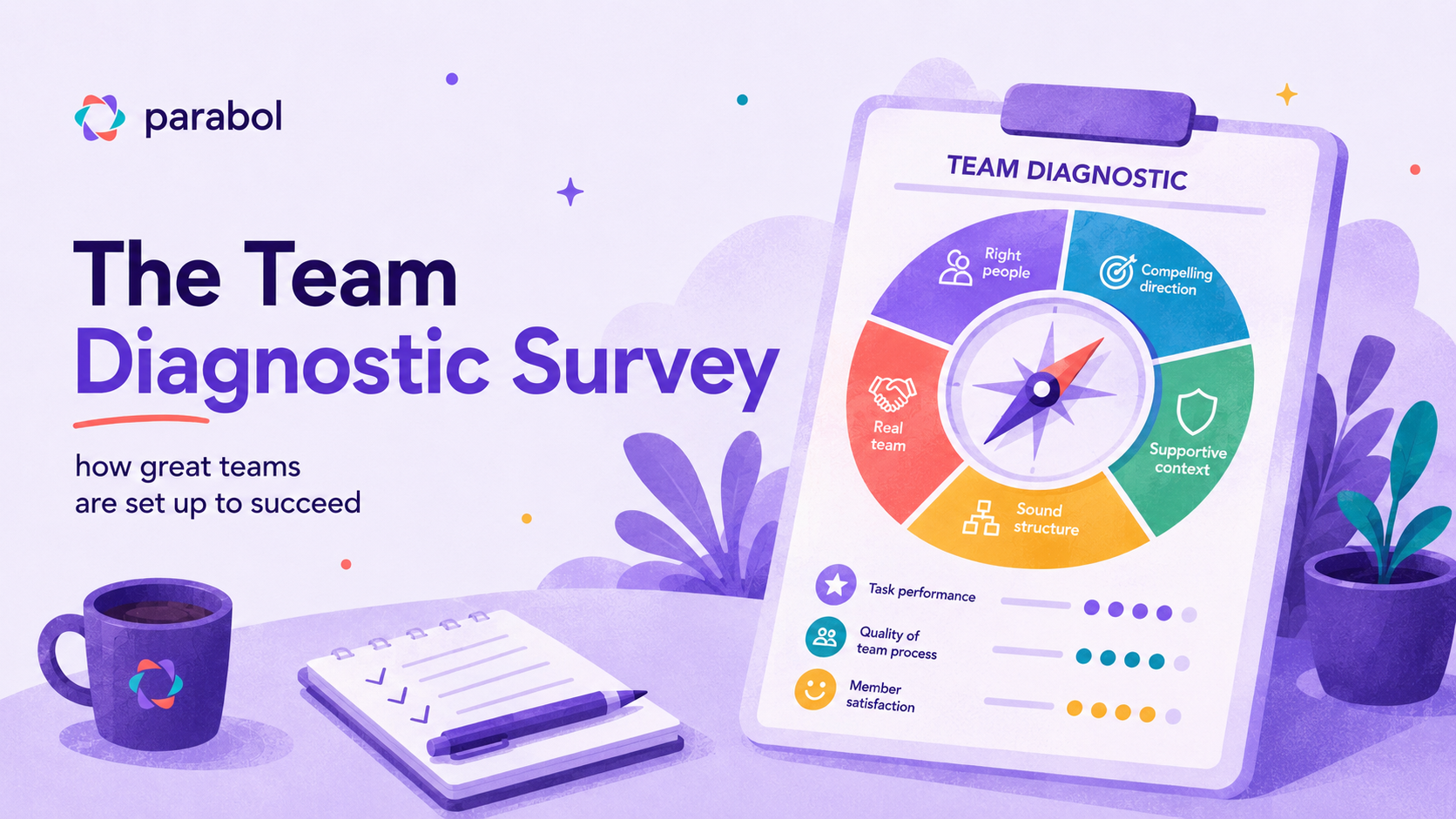
When a team is underperforming, the instinct is to fix the people in it. Run better stand-ups. Coach the quiet ones. Have a hard conversation about accountability. You pour your energy into how the team behaves day to day — and the needle barely moves.
Harvard psychologist J. Richard Hackman spent decades arguing the real problem usually shows up much earlier. Most of what makes a team succeed or fail, he found, is decided before the work even begins — in how the team is set up, resourced, and pointed at a goal. The Team Diagnostic Survey is the tool built to measure exactly that.
📌 Want to run a team health check now? Try Parabol Health Check — measure your team in a few minutes.
What is the Team Diagnostic Survey, and why use it?
The team diagnostic survey (TDS) is a research-backed questionnaire that measures whether a team has the conditions it needs to do great work. Instead of only asking “is this team performing?”, it asks the more useful question: “is this team set up to perform?”
That distinction is the whole point. A lot of team assessments measure symptoms — low morale, missed deadlines, tense meetings. The TDS looks upstream, at the enabling conditions: the structural and contextual ingredients (a clear direction, the right people, a sound design, real organizational support) that make good teamwork likely in the first place. Get those right, Hackman argued, and good process tends to follow. Get them wrong, and no amount of team-building will save you.
It’s a strong fit if you lead or coach a team and you suspect the friction you’re seeing has roots you can’t quite name. It works for any team — a product squad, a support pod, a leadership group, a cross-functional project team — because the conditions it measures are universal, not industry-specific.
Where the Team Diagnostic Survey came from
Hackman built his career on a counterintuitive idea: by the time a team sits down to work, most of the factors that will determine its success are already locked in. Leaders, he believed, have far more leverage designing a team well than managing it day to day. He estimated that the lion’s share of a team’s effectiveness is set by these upfront conditions.
To turn that idea into something you could actually measure, Hackman teamed up with Ruth Wageman and Erin Lehman. They published the instrument in “Team Diagnostic Survey: Development of an Instrument” in the Journal of Applied Behavioral Science in 2005, validating it across 2,474 respondents on real teams. The survey assesses how well a team is structured, supported, and led, alongside three effectiveness outcomes:
- Task performance — does the team deliver work that meets the standards of the people who use it?
- Quality of group process — is the team getting better at working together over time, not worse?
- Member satisfaction — is being on this team a positive, growth-filled experience for the people in it?
Hackman’s thinking is now stewarded as the Six Team Conditions: a real team (with clear membership and boundaries), a compelling direction, the right people, a sound structure, a supportive context, and team coaching. Two are considered “essentials” and the rest “enablers,” but the message is consistent — effectiveness is engineered up front, then nurtured.
📌 Go deeper: The full, validated instrument is proprietary and licensed. To run the official survey or read the research firsthand, see the Six Team Conditions (the Hackman steward) and the original 2005 paper.
What’s inside the Team Diagnostic Survey
Here’s an honest note before the questions, because it matters. The TDS itself is a proprietary, licensed instrument — we’re not reproducing its items. The questions below are Parabol-worded probes, written by us to reflect Hackman’s named conditions and outcomes in plain, team-friendly language. They’re a faithful interpretation, not the real survey. If you want the validated instrument with official scoring, go to 6teamconditions.com.
What we can do cleanly is map Hackman’s conditions onto Parabol’s five team health categories, so the idea slots into a pulse you can actually run. Here’s how the pieces line up:
| Hackman’s condition / outcome | Parabol category |
|---|---|
| Supportive context & shared norms | Psychological safety |
| Right people · quality of group process | Dependability |
| Compelling direction · sound structure | Structure & clarity |
| Member satisfaction & growth | Meaning |
| Task performance | Impact |
Now the probes, grouped by category. Each set opens with why it matters.
Psychological safety
Hackman’s supportive context condition is about whether the team has what it needs to thrive — including healthy norms for how people treat each other. When the organization backs a team and the team has clear ground rules, people feel safe enough to do their best work.
- Our team has clear, shared norms for how we treat each other and handle disagreement.
- The wider organization gives our team the support and respect it needs to do good work.
Dependability
This maps to Hackman’s right people condition and his quality of group process outcome. A team isn’t just a roster — it’s whether the mix of skills fits the job, and whether the team keeps getting better at working together rather than stalling.
- This team has the right mix of people and skills to get its work done.
- Our team keeps getting better at how we work together.
Structure & clarity
This is the heart of Hackman’s argument: a compelling direction and a sound structure. People need to know where the team is headed and how the work is organized — including the basic but often-missed question of who is even on the team.
- Our team has a clear, compelling direction that everyone understands.
- Our work is well organized — it’s clear what we do and how we do it.
- It’s clear who is, and who isn’t, part of our team.
Meaning
Hackman’s member satisfaction outcome treats a team as a place people grow, not just a place work gets done. A healthy team is one its members find genuinely worthwhile to be part of.
- Being on this team contributes to my own learning and growth.
- The experience of working on this team is satisfying and worthwhile to me.
Impact
This reflects the task performance outcome — the bottom line. Does the work actually land with the people who depend on it?
- The results of our work meet or exceed the standards of the people who use them.
- Our team consistently delivers outcomes that matter to our customers and stakeholders.
How to use this thinking with your team
You don’t need a license to put Hackman’s core insight to work. The shift is simple: stop treating every team problem as a behavior problem, and start asking whether the conditions are in place.
Run it as a short, anonymous pulse. Pick one or two probes per category and ask the team to rate each on a simple agree/disagree scale. Anonymity matters most here — people won’t tell you the direction is fuzzy or the team is missing a key skill if their name is attached.
Read the low scores as design questions, not blame. If “our team has a clear, compelling direction” comes back weak, that’s not a sign your people lack commitment — it’s a sign the direction needs sharpening, which is your job to fix. That reframe is the whole gift of Hackman’s model.
Revisit the basics for new or reshuffled teams. Hackman put surprising weight on whether a team is even a real team — stable membership, clear boundaries. If people aren’t sure who’s in, start there before anything else.
Make it a habit, not an event. Conditions drift. A quarterly check keeps you ahead of the slow erosion that’s hard to spot from inside the work.
Run a Team Health check in Parabol
Hackman’s enabling conditions are part of the thinking behind Parabol’s Team Health check. Parabol’s Team Health check lets your team rate how you’re doing across five research-backed categories — psychological safety, dependability, structure & clarity, meaning, and impact — as a quick, recurring, anonymous pulse, then turns the results into a conversation.
Related models
Hackman’s work pairs naturally with other team-effectiveness frameworks. Each of these maps onto the same five categories, so you can mix and match.
- 📌 Google Project Aristotle — the study behind Parabol’s five categories, and a great companion read on what actually makes teams effective.
- 📌 The Five Dysfunctions of a Team — Lencioni’s practitioner take, strong where surveys are often weak: trust, conflict, and accountability.
- 📌 Atlassian Team Health Monitor — a facilitated workshop format for self-assessing against healthy-team attributes.
- 📌 Explore all the frameworks on the Team Health Check Tool hub.
FAQ
Is the Team Diagnostic Survey free to use?
The full, validated TDS is a proprietary instrument that requires a license — you can access the official version through the Six Team Conditions stewards. The probes on this page are Parabol’s own plain-language interpretation of Hackman’s conditions, free to adapt for an informal team check.
Who created the Team Diagnostic Survey?
It was developed by Ruth Wageman, J. Richard Hackman, and Erin Lehman, and published in the Journal of Applied Behavioral Science in 2005, validated on 2,474 respondents.
What are the six team conditions?
A real team, a compelling direction, the right people, a sound structure, a supportive context, and team coaching. They’re the modern framing of Hackman’s “enabling conditions” — the factors that set a team up to succeed before the work begins.
How is the TDS different from Project Aristotle or the Five Dysfunctions?
The TDS looks upstream at whether a team’s conditions are well designed, while models like Project Aristotle measure the team dynamics that result. They complement each other: fix the conditions, and the dynamics tend to follow.
Are the questions on this page the actual TDS items?
No. The TDS instrument is licensed and not reproduced here. These are Parabol-worded probes grounded in Hackman’s named conditions and outcomes — use them for an informal pulse, and use the official instrument when you need validated scoring.