Lencioni’s model, the assessment, and how to run it
The Five Dysfunctions of a Team
You can usually feel when a team isn’t clicking. Meetings stay polite but nothing real gets said. Decisions get “agreed” in the room and quietly ignored after. Deadlines slip and nobody names it. The frustrating part is that no single person is the problem, so there’s nothing obvious to fix.
Patrick Lencioni’s five dysfunctions of a team gives that vague unease a shape. It traces team trouble down to one root cause, shows how each problem feeds the next, and gives you a short assessment to find out where your team actually stands. Here’s the model, the questions, and how to run it.
📌 Want to run this now? Try Parabol Health Check — measure your team in a few minutes.
What is the five dysfunctions model, and why use it?
The five dysfunctions of a team is a framework for diagnosing why teams underperform, created by management consultant Patrick Lencioni. Instead of treating low morale, missed goals, and bad meetings as separate issues, it argues they’re symptoms of the same chain of problems — and that the chain starts with a lack of trust.
Most team surveys are good at measuring engagement or clarity. They’re weaker on the messy human stuff: whether people trust each other, argue productively, and hold each other to account. That’s exactly where this model is strong. If your team is technically capable but somehow stuck — quiet meetings, vague commitments, finger-pointing when things go wrong — this is the lens that tends to explain it.
It’s built for any team with a shared goal: a leadership group, an engineering squad, a marketing pod, a nonprofit board. You don’t need to be in software to use it.
Where the five dysfunctions of a team came from
In 2002, Lencioni published The Five Dysfunctions of a Team — not as a textbook, but as a leadership fable. Most of the book is a story about a fictional Silicon Valley company and a new CEO who inherits a talented but dysfunctional executive team. Only at the end does Lencioni step back and lay out the model directly. That storytelling is a big reason the book has sold millions of copies and stuck around in leadership circles for two decades.
Lencioni is the founder of The Table Group, a management consultancy, and the model grew out of his work advising executive teams. The book includes a short team assessment so groups can locate their own weak spots.
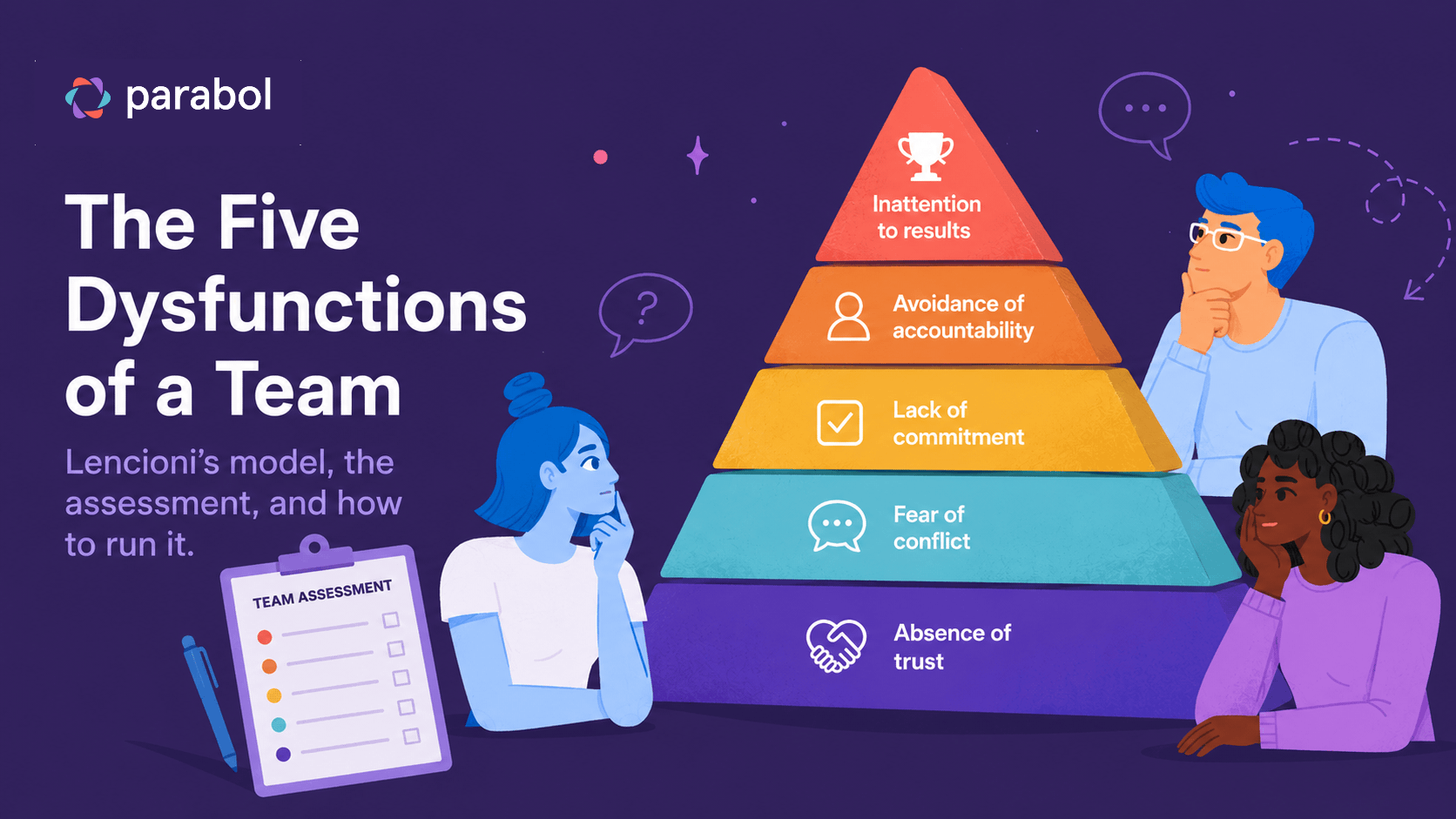
The core idea is a pyramid. Five dysfunctions stack on top of each other, and each one makes the next more likely. You can’t fix the upper layers until you’ve dealt with the foundation:
- Absence of trust — people hide weaknesses and mistakes from each other.
- Fear of conflict — without trust, teams avoid honest debate and settle for artificial harmony.
- Lack of commitment — without real debate, people don’t truly buy into decisions, even ones they nodded along to.
- Avoidance of accountability — without commitment, people hesitate to call out peers whose behavior hurts the team.
- Inattention to results — without accountability, individuals drift toward their own goals, status, and ego instead of the team’s outcomes.
The power of the model is in that bottom-up logic. A team that can’t have a hard conversation usually doesn’t have a debate problem — it has a trust problem one layer down. Fix the foundation and the layers above get easier.
What’s inside the model: the five dysfunctions as their healthy inverse
Lencioni frames the model around what goes wrong, but the assessment measures the healthy version of each layer. We’ve kept that positive framing here and organized the statements under Parabol’s five team health categories — psychological safety, dependability, structure & clarity, meaning, and impact — so you can see exactly how Lencioni’s pyramid lines up with the rest of your team health picture.
A note on the questions: Lencioni’s 15-item assessment is a published, proprietary instrument from his book. We don’t reproduce it in full here. Below we quote a few representative statements directly (with citation) and present the rest in Parabol’s own adapted, positively-phrased wording. For the complete instrument and scoring, see The Five Dysfunctions of a Team (Jossey-Bass, 2002).
Here’s how the pyramid maps to Parabol’s categories:
| Lencioni layer | Parabol category |
|---|---|
| Absence of trust | Psychological safety |
| Fear of conflict | Psychological safety (decision quality also touches structure & clarity) |
| Lack of commitment | Structure & clarity |
| Avoidance of accountability | Dependability |
| Inattention to results | Impact |
Psychological safety (trust + healthy conflict)
This is the base of the pyramid, and it covers two layers: vulnerability-based trust and the productive conflict it makes possible. Psychological safety means people feel safe to be honest — to admit a mistake, ask a dumb question, or disagree out loud — without fear of looking weak. When that safety is missing, meetings go quiet and the real issues stay off the table.
In Lencioni’s words, on a healthy team “team members openly admit their weaknesses and mistakes” and “are passionate and unguarded in their discussion of issues” (Lencioni, 2002). The rest, in Parabol’s phrasing:
- Team members quickly and genuinely apologize when something they said or did hurt the team.
- People are comfortable talking about their lives outside of work with one another.
- The most important and difficult issues get put on the table and worked through, not avoided.
- Our team meetings are genuinely compelling and engaging.
Dependability (accountability)
Lencioni’s fourth layer is peer accountability — the willingness to hold each other to a standard rather than leaving it all to the manager. That maps to dependability: the confidence that teammates will follow through and that the team won’t quietly tolerate work slipping. The hard part isn’t holding yourself accountable; it’s being willing to call a peer on something.
A representative item: on a healthy team, “team members are deeply concerned about the prospect of letting down their peers” (Lencioni, 2002). In Parabol’s phrasing:
- Team members are willing to call out one another’s unproductive behaviors.
- People challenge each other’s plans and approaches openly.
Structure & clarity (commitment)
The third layer is commitment — and Lencioni’s insight is that commitment isn’t about consensus. It’s about clarity. People will get behind a decision they argued against, as long as they were heard and the decision is unambiguous. That’s structure & clarity: clear goals, clear decisions, and a shared understanding of who’s doing what.
One representative item: healthy teams “end discussions with clear, specific resolutions and calls to action” (Lencioni, 2002). In Parabol’s phrasing:
- Team members know what their peers are working on and how it contributes to the team.
- People leave meetings confident that everyone is committed to the decision, even after disagreeing.
Impact (results)
The top of the pyramid is collective results — putting the team’s outcomes ahead of individual ego, status, or department. That maps to impact: the belief that the work matters and that we’re winning or losing together. In Parabol’s phrasing:
- Team members willingly make sacrifices in their own areas for the good of the team.
- Our morale is genuinely affected by whether we hit our team goals.
- People are quick to point out others’ contributions and slow to seek credit for themselves.
One honest gap: meaning
Lencioni’s model has no dedicated “meaning” dimension — nothing that asks whether the work itself feels personally significant to people. That’s not a flaw so much as a scope choice; the pyramid is about how a team works together, not why each person finds the work worthwhile.
If you care about meaning — and for retention and motivation, you probably should — pair this assessment with a model that covers it, like Google’s Project Aristotle or the Gallup Q12. Parabol’s five categories include meaning for exactly this reason, so it’s easy to add a question or two and get the full picture.
How to run the five dysfunctions assessment with your team
The model works best as a recurring conversation, not a one-time quiz. Here’s a simple way to run it.
Make it anonymous the first time. Trust is the whole point of the exercise, and you can’t measure honesty with a method that punishes it. An anonymous pulse lowers the stakes so people answer truthfully. Once trust is higher, named responses become more useful — but start safe.
Use a simple agree/disagree scale. Lencioni’s book uses a three-point frequency scale (usually / sometimes / rarely). For a regular pulse, a standard agree-to-disagree scale works just as well, and every statement above is keyed so that more agreement = healthier. That keeps your trend lines easy to read.
Read the results bottom-up. This is the part most teams get wrong. If accountability scores low, don’t start there — check trust and conflict first. A team that won’t hold each other accountable usually can’t, because it isn’t safe to be that direct yet. Start at the base of the pyramid and work up.
Discuss in the open, fix one layer at a time. Share the aggregate results with the team and pick the lowest healthy layer to work on together. Trust-building is slow and personal; commitment and accountability often improve fast once the foundation is there.
Re-run it on a cadence. Quarterly is a good rhythm for most teams — often enough to catch drift, rare enough that it doesn’t feel like surveillance. Watch the trend, not any single score.
Run a Team Health check in Parabol
The Five Dysfunctions model is one of the frameworks that shaped how we think about team health. Parabol’s Team Health check lets your team rate how you’re doing across five research-backed categories — psychological safety, dependability, structure & clarity, meaning, and impact — as a quick, recurring, anonymous pulse, then turns the results into a conversation.
Related models
The five dysfunctions is strong on trust and accountability but light on a few areas. These pair well with it:
📌 Go deeper: Project Aristotle — Google’s research-backed five dynamics of effective teams, and the source of Parabol’s five categories. A great complement for the meaning dimension Lencioni skips.
📌 Go deeper: Psychological safety — Amy Edmondson’s research on the base of the pyramid: why people speak up, and what happens when they can’t.
📌 Go deeper: Team Diagnostic Survey — Hackman’s research-grade look at the conditions that set teams up to succeed.
Browse all of them on the Team Health Check Tool hub.
Frequently asked questions
What are the five dysfunctions of a team?
They are absence of trust, fear of conflict, lack of commitment, avoidance of accountability, and inattention to results. Patrick Lencioni laid them out in his 2002 book as a pyramid, where each dysfunction enables the one above it — so the foundation, trust, has to come first.
Who created the five dysfunctions model?
Patrick Lencioni, a management consultant and founder of The Table Group, introduced it in his 2002 leadership fable The Five Dysfunctions of a Team (Jossey-Bass). The book teaches the model through a story before laying it out directly at the end.
Is the five dysfunctions assessment free?
The full 15-item assessment and its scoring are published in Lencioni’s book and through The Table Group. You can run an adapted, positively-phrased version of the questions as a team pulse — like the statements on this page — using a tool such as Parabol’s Team Health check.
Why does the model start with trust?
Because, in Lencioni’s logic, every layer above depends on it. Without vulnerability-based trust, people won’t engage in honest conflict; without conflict, they won’t truly commit; without commitment, they won’t hold each other accountable; and without accountability, they drift away from shared results. Fix the base and the rest gets easier.
Does the five dysfunctions model cover meaning or purpose?
No. It focuses on how a team works together, not on whether the work feels personally meaningful. To cover that, pair it with a model like Project Aristotle or the Gallup Q12, both of which include a meaning or purpose dimension.
Sources
- Lencioni, P. (2002). The Five Dysfunctions of a Team: A Leadership Fable. Jossey-Bass — the book containing the model and the 15-item assessment.
- The Table Group — Patrick Lencioni’s consultancy, with additional resources on the model.