A workshop to catch team trouble early
The Atlassian Team Health Monitor
You can usually feel when a team is struggling. Standups get quieter. The same complaints surface in every one-on-one. Work that used to flow now stalls for no clear reason. But “I think morale is low” is a hard thing to act on — it’s a hunch, not a starting point.
The Atlassian Team Health Monitor turns that hunch into a conversation. It’s a short workshop that gets your whole team in one room to rate how they’re really doing, name the sore spots out loud, and agree on what to fix first. No dashboards. No guesswork. Just an honest hour together.
📌 Want to run this now? Try Parabol Health Check — measure your team in a few minutes.
What is the Atlassian Team Health Monitor, and why use it?
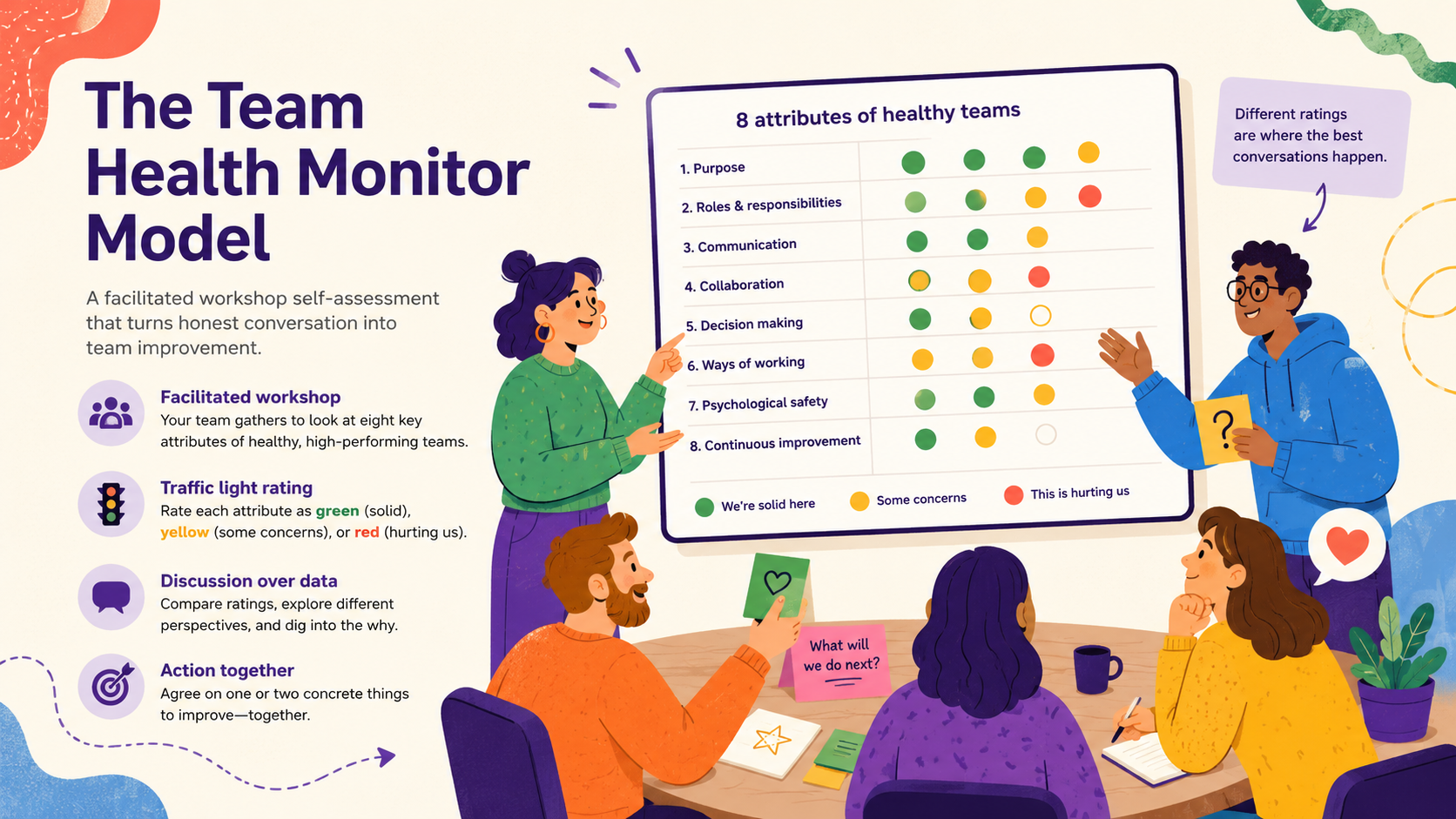
The Atlassian Team Health Monitor is a facilitated workshop self-assessment. Your team gathers, looks at eight attributes that healthy, high-performing teams tend to share, and rates itself on each one using a simple traffic light: green (we’re solid here), yellow (some concerns), or red (this is hurting us).
Here’s the part that makes it different from most check-ins: it is not an anonymous survey. There’s no form to fill out alone at your desk. The whole point is the discussion. Everyone rates an attribute, the ratings go up where the group can see them, and then the team talks about why — especially when the colors don’t match. One person’s green next to someone else’s red is not a problem to smooth over. It’s the most useful moment in the room.
That makes the Atlassian Team Health Monitor a good fit when you want shared ownership of the result, not just data for a manager. It works best for an intact team that meets regularly — a squad, a project team, a leadership group — and that’s mature enough to be honest in front of each other. If your team is brand new, or trust is already badly frayed, a lighter or more anonymous check may be a gentler place to start.
The payoff is a team that has said the quiet part out loud and walked away with one or two concrete things to improve — together.
Where the Atlassian Team Health Monitor came from
The Atlassian Team Health Monitor is part of the Atlassian Team Playbook, a free, public collection of group exercises (Atlassian calls them “plays”) that the company built from how its own teams work. The Playbook’s whole premise is practical: stop guessing about team problems, run a structured exercise, and act on what you learn.
The company describes the Atlassian Team Health Monitor as “a structured way for teams to self-assess against 8 attributes we’ve found to be common amongst healthy, high-performing teams.” In other words, it isn’t an academic instrument with decades of validation studies behind it. It’s a field-tested workshop, designed to be run by the team, for the team, on a repeating cadence so you can watch the colors shift over time.
One useful detail: Atlassian publishes role-specific variants of the Atlassian Team Health Monitor — versions tuned for project teams, leadership teams, and service teams — because what “healthy” looks like shifts with the kind of work a group does. The eight attributes below are the general-purpose set most teams start with. If one of the specialized versions fits your group better, the format is identical; only the attributes change.
What’s inside the Atlassian Team Health Monitor
The Atlassian Team Health Monitor’s eight attributes are written as short prompts to discuss. To make them easy to compare with other models — and to plug straight into a recurring pulse — we’ve rephrased each one as a positive statement your team can agree or disagree with, and grouped them under Parabol’s five Team Health categories.
Those five categories come from Google’s Project Aristotle research into what makes teams effective: psychological safety, dependability, structure and clarity, meaning, and impact. Mapping Atlassian’s attributes onto them shows exactly which parts of team health the Atlassian Team Health Monitor covers well — and where it’s thin.
Here’s how the eight attributes line up:
| Atlassian attribute | Parabol category |
|---|---|
| Team cohesion | Psychological safety |
| Encouraging difference | Psychological safety |
| Engagement & support | Psychological safety |
| Continuous improvement | Dependability |
| Balanced team | Structure & clarity |
| Suitable ways of working | Structure & clarity |
| Shared understanding | Structure & clarity |
| Value and metrics | Impact |
Psychological safety
Three of the eight attributes land here, which tells you where Atlassian puts its emphasis: whether people on the team actually trust each other enough to be candid. This category is about feeling safe to speak up, disagree, and ask for help without fear of looking foolish.
- There is a high level of mutual trust and respect on our team. (attribute: Team cohesion)
- People feel safe to voice diverse viewpoints and challenge the status quo. (attribute: Encouraging difference)
- Team members are engaged, and support each other when things get tough. (attribute: Engagement & support)
Dependability
Dependability is about being able to count on one another to follow through. The Atlassian Team Health Monitor touches it through the team’s habit of improving how it works — a team that reliably learns from its mistakes is a team you can depend on.
- We regularly reflect and take action to get better at how we work. (attribute: Continuous improvement)
Structure and clarity
This is the Atlassian Team Health Monitor’s other center of gravity. Structure and clarity means everyone understands the goals, the roles, and the way work gets done. Three attributes probe whether your team has the right setup to succeed.
- We have the right people and skills, and roles are clearly defined. (attribute: Balanced team)
- Our ways of working suit the team and the work we do. (attribute: Suitable ways of working)
- We share a clear, common understanding of our mission and milestones. (attribute: Shared understanding)
Impact
Impact is the belief that the work matters and that you can see the difference it makes. The Atlassian Team Health Monitor covers it with a single, pointed attribute about value.
- We’re clear on the value we provide and how we measure it. (attribute: Value and metrics)
One gap worth noting: Meaning
You’ll notice the table has no row for Meaning — the sense that the work is personally significant to the people doing it. The Atlassian Team Health Monitor doesn’t include a standalone item for it; “Shared understanding” carries the closest sense of purpose, but it’s really about clarity, not personal meaning.
That’s not a flaw, just a boundary. If you care about whether people find their work fulfilling, pair the Atlassian Team Health Monitor with a question or two on meaning from a model like Google Project Aristotle or Gallup’s Q12.
All eight attributes are drawn from the Atlassian Team Playbook — Health Monitor and the About the Team Health Monitor write-up.
How to run the Atlassian Team Health Monitor with your team
Running it as a team health check workshop is refreshingly simple. You don’t need special training — just a facilitator, your team, and about an hour.
- Pick a facilitator and set the tone. Ideally this is someone neutral, not the team’s boss, so people speak freely. Open by making it clear this is about helping the team, not grading anyone.
- Walk through each attribute. Read it out, make sure everyone understands what it means, and give a quick example of what “green” versus “red” looks like in practice.
- Vote at the same time. Have everyone reveal their rating at once — a thumb, a card, or a click. Voting simultaneously stops people from anchoring on the loudest voice or the manager’s opinion.
- Talk about the splits. Where ratings disagree, dig in. A red-next-to-green is a signal that people are experiencing the team differently, and that’s exactly what you want to surface.
- Pick one or two things to act on. Don’t try to fix all eight. Choose the attributes that matter most right now, agree on a concrete next step for each, and decide who owns it.
- Run it again on a cadence. Every four to eight weeks works for most teams. The colors over time tell the real story — a yellow drifting toward green means your changes are landing.
A few things to protect: keep it safe, keep the boss’s vote from dominating, and always end with action. A health check that surfaces problems but changes nothing will quietly teach your team that speaking up is pointless.
Run a Team Health check in Parabol
The Atlassian Team Health Monitor is one of the frameworks that shaped how we think about team health. Parabol’s Team Health check lets your team rate how you’re doing across five research-backed categories — psychological safety, dependability, structure & clarity, meaning, and impact — as a quick, recurring, anonymous pulse, then turns the results into a conversation.
Related models
The Atlassian Team Health Monitor is one of several practical ways to take your team’s temperature. If you’re shopping for the right fit, these pair well with it:
📌 Spotify Squad Health Check — Another agile-native, traffic-light workshop. The closest cousin to the Atlassian Team Health Monitor, and a great alternative if you want a more software-squad flavor.
📌 Team Diagnostic Survey — Hackman’s research-backed instrument, for when you want the science behind why a team is or isn’t set up to succeed.
📌 Google Project Aristotle — The study behind the five categories in this guide, and the best place to start if you want the evidence base for what makes teams effective.
You can browse all of these from the Team Health Check Tool hub.
FAQ
Is the Atlassian Team Health Monitor a survey?
No — and that’s the point. It’s a facilitated workshop where the team rates eight attributes red, yellow, or green together and then discusses the results out loud. The conversation, especially where ratings disagree, is where the value lives. If you specifically want anonymity, run a separate anonymous pulse instead.
How many attributes does the Atlassian Team Health Monitor measure?
Eight: team cohesion, encouraging difference, engagement and support, continuous improvement, balanced team, suitable ways of working, shared understanding, and value and metrics. Atlassian also publishes role-specific variants — for project, leadership, and service teams — with attributes tuned to each.
How often should we run it?
Most teams run it every four to eight weeks. The Atlassian Team Health Monitor is designed to be repeated so you can track how each attribute’s color shifts over time — that trend matters more than any single session’s snapshot.
Is the Atlassian Team Health Monitor free?
Yes. It’s part of the free, public Atlassian Team Playbook, and you can run it with sticky notes and a whiteboard. Tools like Parabol simply make it faster to facilitate and easier to track over time.
What does the Atlassian Team Health Monitor not cover?
It’s light on Meaning — whether the work feels personally significant — and has only one attribute each for dependability and impact. Pair it with a model like Project Aristotle or Gallup’s Q12 if those areas matter to you.